| Code based measurements
|
- Code measurements (also referred to as pseudorange measurements) enable instantaneous position determinations using GPS satellites.
- Pseudoranges to four satellites are used to determine position by removing uncertainties in (a) X, Y, Z and (b) receiver clocks and then corrected to produce the range.
Positioning accuracy is a function of intersection geometry and range measurement accuracy.
- Code measurements are the difference in time between when the code is transmitted from a satellite and received at a GPS receiver, multiplied by the speed of light.
measured code pseudorange (P) = c (t i - tj )
|
P measured code
c speed of light
t i signal reception time
t j signal transmission time
|
- It represents a direct measurement of satellite to receiver range and can be expressed as
measured code pseudorange = range + errors
P = ρ + errors
|
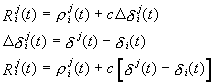
| As shown earlier in Lecture 11, a simplified code pseudorange at an epoch t between receiver i and satellite j can be given by the following equations
|
|
 |
Measured code pseudorange between the receiver i and the satellite j
|
 |
Geometric distance between the satellite j and the receiver i
|
 |
Combined clock offset of the satellite and the receiver clock, with respect to GPS time.
|
| C |
Speed of light
|
 |
| (X j (t), Y j (t), Z j(t)) satellite coordinates at epoch/time t
|
| (X i , Y i , Z i ) receiver coordinates
|
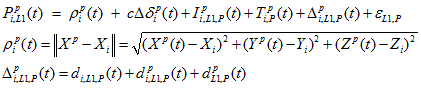
| A general pseudorange equation with different errors can be written as (Leick, 2004)
|
|
|
| |
|
- Pseudorange between receiver i and satellite p at time t for L1 frequency
|
|
|
|
- Ionospheric delay at L1, depends on ionospheric conditions along the path and on frequency, always positive since code is slowed down by the ionosphere
|
|
- Tropospheric delay, depends on tropospheric conditions along path but independent of carrier frequency. Hence, no subscript to identify it, always positive
|
|
- Receiver hardware delay, independent of satellite observed
|
|
- Multipath delay, depends on direction of satellite observed
|
|
|
|
- Pseudorange measurement noise (approx 30 cm for P(Y) code more for C/A code depending on technique used)
|
| |