|
Summit curves are vertical curves with gradient upwards.
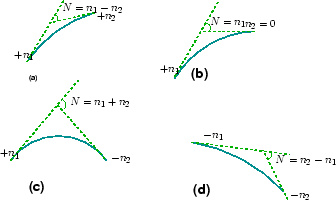
They are formed when two gradients meet as illustrated in figure
1 in any of the following four ways:
- when a positive gradient meets another positive gradient
[figure 1a].
- when positive gradient meets a flat gradient
[figure 1b]. .
- when an ascending gradient meets a descending gradient
[figure 1c]. .
- when a descending gradient meets another descending gradient
[figure 1d]. .
Many curve forms can be used with satisfactory results, the common practice has
been to use parabolic curves in summit curves.
This is primarily because of the ease with it can be laid out as well as
allowing a comfortable transition from one gradient to another.
Although a circular curve offers equal sight distance at every point on the
curve, for very small deviation angles a circular curve and parabolic curves
are almost congruent.
Furthermore, the use of parabolic curves were found to give excellent riding
comfort.
Figure 1:
Types of summit curves
 |
In determining the type and length of the vertical curve, the design
considerations are comfort and security of the driver, and the appearance of
the profile alignment.
Among these, sight distance requirements for the safety is most important on
summit curves.
The stopping sight distance or absolute minimum sight distance should be
provided on these curves and where overtaking is not prohibited, overtaking
sight distance or intermediate sight distance should be provided as far as
possible.
When a fast moving vehicle travels along a summit curve, there is less
discomfort to the passengers.
This is because the centrifugal force will be acting upwards while the vehicle
negotiates a summit curve which is against the gravity and hence a part of the
tyre pressure is relieved.
Also if the curve is provided with adequate sight distance, the length would be
sufficient to ease the shock due to change in gradient.
Circular summit curves are identical since the radius remains same throughout
and hence the sight distance.
From this point of view, transition curves are not desirable since it has
varying radius and so the sight distance will also vary.
The deviation angle provided on summit curves for highways are very large, and
so the a simple parabola is almost congruent to a circular arc, between the
same tangent points.
Parabolic curves is easy for computation and also it had been found out that it
provides good riding comfort to the drivers.
It is also easy for field implementation.
Due to all these reasons, a simple parabolic curve is preferred as summit
curve.
|
|

