|
The effect of long steep gradient on the vehicular speed is considerable.
This is particularly important in roads where the proportion of heavy vehicles
is significant.
Due to restrictive sight distance at uphill gradients the speed of traffic is
often controlled by these heavy vehicles.
As a result, not only the operating costs of the vehicles are increased, but
also capacity of the roads will have to be reduced.
Further, due to high differential speed between heavy and light vehicles, and
between uphill and downhill gradients, accidents abound in gradients.
The positive gradient or the ascending gradient is denoted as  and the
negative gradient as and the
negative gradient as  .
The deviation angle .
The deviation angle  is: when two grades meet, the angle which measures the
change of direction and is given by the algebraic difference between the two
grades is: when two grades meet, the angle which measures the
change of direction and is given by the algebraic difference between the two
grades
 .
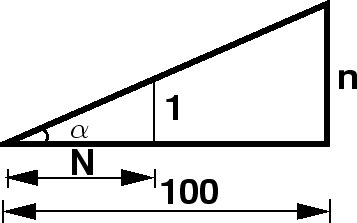
Example: 1 in 30 = 3.33% .
Example: 1 in 30 = 3.33%  is a steep gradient, while 1 in 50 =
2% is a steep gradient, while 1 in 50 =
2%
 is a flatter gradient.
The gradient representation is illustrated in the figure 1. is a flatter gradient.
The gradient representation is illustrated in the figure 1.
Figure 1:
Representation of gradient
 |
Many studies have shown that gradient upto seven percent can have considerable
effect on the speeds of the passenger cars.
On the contrary, the speeds of the heavy vehicles are considerably reduced when
long gradients as flat as two percent is adopted.
Although, flatter gradients are desirable, it is evident that the cost of
construction will also be very high.
Therefore, IRC has specified the desirable gradients for each terrain.
However, it may not be economically viable to adopt such gradients in certain
locations, steeper gradients are permitted for short duration.
Different types of grades are discussed below and the recommended type of
gradients for each type of terrain and type of gradient is given in table
1.
Table 1:
IRC Specifications for gradients for different roads
| Terrain |
Ruling |
Limitings |
Exceptional |
| Plain/Rolling |
3.3 |
5.0 |
6.7 |
| Hilly |
5.0 |
6.0 |
7.0 |
| Steep |
6.0 |
7.0 |
8.0 |
Ruling gradient, limiting gradient, exceptional gradient and minimum gradient
are some types of gradients which are discussed below.
The ruling gradient or the design gradient is the maximum gradient with which
the designer attempts to design the vertical profile of the road.
This depends on the terrain, length of the grade, speed, pulling power of the
vehicle and the presence of the horizontal curve.
In flatter terrain, it may be possible to provide flat gradients, but in hilly
terrain it is not economical and sometimes not possible also.
The ruling gradient is adopted by the designer by considering a particular
speed as the design speed and for a design vehicle with standard dimensions.
But our country has a heterogeneous traffic and hence it is not possible to lay
down precise standards for the country as a whole.
Hence IRC has recommended some values for ruling gradient for different types
of terrain.
|

