Text_Template
  Module 3: Geometric design of highways
Lecture 17 Vertical alignment I
  

Case b. Length of summit curve less than sight distance

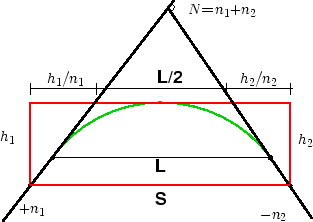
The second case is illustrated in figure 1
Figure 1: Length of summit curve ($L<S$)
\begin{figure}\centerline{\epsfig{file=../../../figeps/g22-summit-curve-details,width=8cm}}\end{figure}

From the basic geometry, one can write

\begin{displaymath}
S=\frac{L}{2}+\frac{h_1}{n_1}+\frac{h_2}{n_2}
=\frac{L}{2}+\frac{h_1}{n_1}+\frac{h_2}{N-n_2}
\end{displaymath} (1)

Therefore for a given $L$, $h_1$ and $h_2$ to get minimum $S$, differentiate the above equation with respect to $h_1$ and equate it to zero. Therefore,
$\displaystyle \frac{dS}{dh_1} = \frac{-h_1}{n_1^2} + \frac{h_2}{{N-{n_1}}^2} = 0
h_1\left(N-n_1\right)^2=$ $\textstyle h_2n_1^2$    
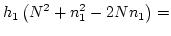
$\displaystyle h_1\left(N^2+n_1^2-2Nn_1\right)=$ $\textstyle h_2n_1^2$    
$\displaystyle h_1N^2+h_1n_1^2-2Nn_1h_1=h_2n_1^2$      
$\displaystyle \left(h_2-h_1\right)n_1^2+2Nh_1n_1-h_1N^2=0$      

Solving the quadratic equation for $n_1$,
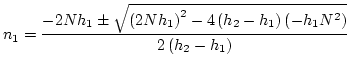
$\displaystyle n_1=\frac{-2Nh_1 \pm \sqrt{\left(2Nh_1\right)^2-4\left(h_2-h_1\right)\left(-h_1N^2\right)}}{2\left(h_2-h_1\right)}$      
$\displaystyle %
=\frac{-2Nh_1+\sqrt{4N^2h_1^2+4h_1N^2h_2-4h_1^2N^2}}{2\left(h_2-h_1\right)}$      
$\displaystyle %
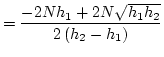
=\frac{-2Nh_1+2N\sqrt{h_1h_2}}{2\left(h_2-h_1\right)}$      
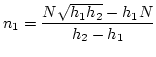
$\displaystyle n_1 = \frac{N\sqrt{h_1 h_2} - h_1N}{h_2 - h_1}$     (2)

Now we can substitute $n$ back to get the value of minimum value of $L$ for a given $n_1$, $n_2$, $h_1$ and $h_2$. Therefore,
\begin{displaymath}
S=\frac{L}{2}+\frac{{h_1}}{\frac{N\sqrt{h_1 h_2}- Nh_1}{h_2 ...
..._2}}{{N-\frac{N\sqrt{h_1 h_2} - Nh_1}{h_2 - h_1}}}\nonumber\\
\end{displaymath}  

Solving for $L$,
  $\textstyle =$ $\displaystyle \frac{L}{2}+\frac{h_1\left(h_2-h_1\right)}{N\left(\sqrt{h_1h_2}-h_1\right)}+\frac{h_2\left(h_2-h_1\right)}{Nh_2-Nh_1-N\sqrt{h_1h_2}+Nh_1}$  
  $\textstyle =$ $\displaystyle \frac{L}{2}+\frac{h_1\left(h_2-h_1\right)}{N\left(\sqrt{h_1h_2}-h_1\right)}+\frac{h_2\left(h_2-h_1\right)}{N\left(h_2-\sqrt{h_1h_2}\right)}$  
  $\textstyle =$ $\displaystyle \frac{L}{2}+\frac{h_1\left(h_2-h_1\right)\left(h_2-\sqrt{h_1h_2}\...
...h_2}-h_1\right)}{N\left(\sqrt{h_1h_2}-h_1\right)\left(h_2-\sqrt{h_1h_2}\right)}$  
  $\textstyle =$ $\displaystyle \frac{L}{2}+\frac{\left(h_2-h_1\right)\left(h_1h_2-h_1\sqrt{h_1h_...
...}-h_1h_2\right)}{N\left(\sqrt{h_1h_2}-h_1\right)\left(h_2-\sqrt{h_1h_2}\right)}$  
  $\textstyle =$ $\displaystyle \frac{L}{2}+\frac{\left(h_2-h_1\right)\left(\sqrt{h_1h_2}\left(h_...
...1\right)\right)}{N\left(h_2\sqrt{h_1h_2}-h_1h_2+h_1\sqrt{h_1h_2}-h_1h_2\right)}$  
  $\textstyle =$ $\displaystyle \frac{L}{2}+\frac{\left(h_2-h_1\right)\sqrt{h_1h_2}\left(\sqrt{h_...
...sqrt{h_2}-\sqrt{h_1}\right)}{N\sqrt{h_1h_2}\left(h_2-2\sqrt{h_1h_2}+h_2\right)}$  
  $\textstyle =$ $\displaystyle \frac{L}{2}+\frac{\left(h_2-h_1\right)\left(\sqrt{h_2}+\sqrt{h_1}\right)\left(\sqrt{h_2}-\sqrt{h_1}\right)}{N\left(\sqrt{h_2}-\sqrt{h_1}\right)^2}$  
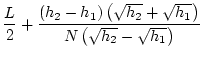
  $\textstyle =$ $\displaystyle \frac{L}{2}+\frac{\left(h_2-h_1\right)\left(\sqrt{h_2}+\sqrt{h_1}\right)}{N\left(\sqrt{h_2}-\sqrt{h_1}\right)}$  
  $\textstyle =$ $\displaystyle \frac{L}{2}+\frac{\left(\sqrt{h_2}+\sqrt{h_1}\right)\left(\sqrt{h...
...\right)\left(\sqrt{h_2}+\sqrt{h_1}\right)}{N\left(\sqrt{h_2}-\sqrt{h_1}\right)}$  
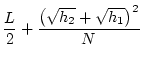
  $\textstyle =$ $\displaystyle \frac{L}{2}+\frac{\left(\sqrt{h_2}+\sqrt{h_1}\right)^2}{N}$  
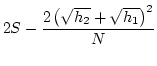
$\displaystyle L$ $\textstyle =$ $\displaystyle 2S-\frac{2\left(\sqrt{h_2}+\sqrt{h_1}\right)^2}{N}$ (3)


\begin{displaymath}
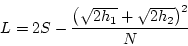
L=2S-\frac{\left(\sqrt{2h_1}+\sqrt{2h_2}\right)^2}{N}
\end{displaymath} (4)

When stopping sight distance is considered the height of driver's eye above the road surface ($h_1$) is taken as 1.2 metres, and height of object above the pavement surface ($h_2$) is taken as 0.15 metres. If overtaking sight distance is considered, then the value of driver's eye height ($h_1$) and the height of the obstruction ($h_2$) are taken equal as 1.2 metres.