|
Width of the carriage way or the width of the pavement depends on the width of
the traffic lane and number of lanes.
Width of a traffic lane depends on the width of the vehicle and the clearance.
Side clearance improves operating speed and safety.
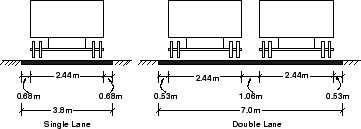
The maximum permissible width of a vehicle is 2.44 and the desirable side
clearance for single lane traffic is 0.68 m.
This require minimum of lane width of 3.75 m for a single lane road
(Figure 1a).
However, the side clearance required is about 0.53 m, on either side and 1.06 m
in the center.
Therefore, a two lane road require minimum of 3.5 meter for each lane
(Figure 1b).
The desirable carriage way width recommended by IRC is given in
Table 1
Table 1:
IRC Specification for carriage way width
| Single lane |
3.75 |
| Two lane, no kerbs |
7.0 |
| Two lane, raised kerbs |
7.5 |
| Intermediate carriage |
5.5 |
| Multi-lane |
3.5 |
Figure 1:
Lane width for single and two lane roads
 |
|
|

