|
Camber or cant is the cross slope provided to raise middle of the road surface
in the transverse direction to drain off rain water from road surface.
The objectives of providing camber are:
- Surface protection especially for gravel and bituminous roads
- Sub-grade protection by proper drainage
- Quick drying of pavement which in turn increases safety
Too steep slope is undesirable for it will erode the surface.
Camber is measured in 1 in n or n% (Eg. 1 in 50 or 2%) and the
value depends on the type of pavement surface.
The values suggested by IRC for various categories of pavement is given in
Table 1.
The common types of camber are parabolic, straight, or combination of them
(Figure 1)
Figure 1:
Different types of camber
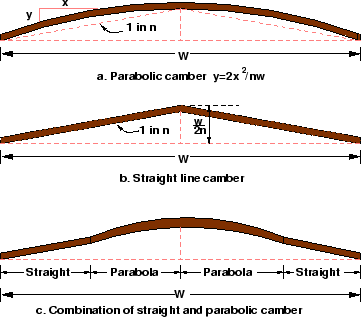 |
Table 1:
IRC Values for camber
| Surface |
Heavy |
Light |
| type |
rain |
rain |
| Concrete/Bituminous |
2 % |
1.7 % |
| Gravel/WBM |
3 % |
2.5 % |
| Earthen |
4 % |
3.0 % |
|
|

