| |
| | |
|
Congestion pricing is a method of road user taxation, charging the users of
congested roads according to the time spent or distance travelled on those
roads.
The principle behind congestion pricing is that those who cause congestion or
use road in congested period should be charged, thus giving the road user the
choice to make a journey or not.
Journey costs include private journey cost, congestion cost, environmental
cost, and road maintenance cost.
The benefit a road user obtains from the journey is the price he prepared to
pay in order to make the journey.
As the price gradually increases, a point will be reached when the trip maker
considers it not worth performing or it is worth performing by other means.
This is known as the critical price. At a cost less than this critical price,
he enjoys a net benefit called as consumer surplus(es) and is given by:
 |
(1) |
where,  is the amount the consumer is prepared to pay, and is the amount the consumer is prepared to pay, and  is the amount
he actually pays.
The basics of congestion pricing involves demand function, private cost
function as well as marginal cost function. These are explained below.
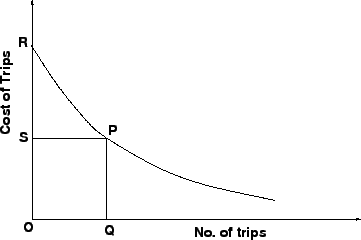
Fig. 1 shows the general form of a demand curve.
In the figure, area QOSP indicates the absolute utility to trip maker and the
area SRP indicates the net benefit. is the amount
he actually pays.
The basics of congestion pricing involves demand function, private cost
function as well as marginal cost function. These are explained below.
Fig. 1 shows the general form of a demand curve.
In the figure, area QOSP indicates the absolute utility to trip maker and the
area SRP indicates the net benefit.
Figure 1:
Demand Curve
 |
Total private cost of a trip, is given by:
 |
(2) |
where,  is the component proportional to distance, is the component proportional to distance,  is the component
proportional to speed, and is the component
proportional to speed, and  is the speed of the vehicle (km/h).
In the congested region, the speed of the vehicle can be expressed as, is the speed of the vehicle (km/h).
In the congested region, the speed of the vehicle can be expressed as,
 |
(3) |
where,  is the flow in veh/hour, is the flow in veh/hour,  and e are constants.
Marginal cost is the additional cost of adding one extra vehicle to the traffic
stream. It reduces speed and causes congestion and results in increase in cost
of overall journey.
The total cost incurred by all vehicles in one hour( and e are constants.
Marginal cost is the additional cost of adding one extra vehicle to the traffic
stream. It reduces speed and causes congestion and results in increase in cost
of overall journey.
The total cost incurred by all vehicles in one hour( ) is given by: ) is given by:
 |
(4) |
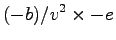
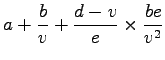
Marginal cost is obtained by differentiating the total cost with respect to the
flow() as shown in the following equations.
Note that c and q in the above derivation is obtained from Equations 2
and 3 respectively.
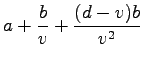
Therefore the marginal cost is given as:
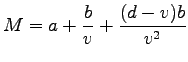 |
(11) |
Fig. 2 shows the variation of marginal cost per flow as well as
private cost per flow.
Figure 2:
Private cost/flow and cost and marginal curve
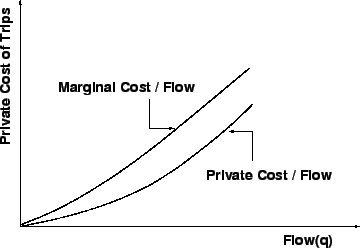 |
It is seen that the marginal cost will always be greater than the private cost,
the increase representing the congestion cost.
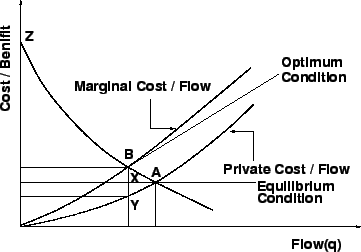
Superimposing the demand curve on the private cost/flow and marginal cost/flow
curves, the position as shown in Fig. 3 is obtained.
The intersection of the demand curve and the private costs curve at point A
represents the equilibrium condition, obtained when travel decisions are based
on private costs only.
The intersection of the demand curve and the marginal costs curve at point B
represents the optimum condition.
At this point the flow  corresponds to the cost corresponds to the cost  which is the
marginal cost as well as the value of the trip to the trip maker.
The net benefit under the two positions A and B are shown by the areas ACZ and which is the
marginal cost as well as the value of the trip to the trip maker.
The net benefit under the two positions A and B are shown by the areas ACZ and
 respectively. If the conditions are shifted from point A to B, the
net benefit due to change will be given by area respectively. If the conditions are shifted from point A to B, the
net benefit due to change will be given by area  minus AXB.
If the area is greater than arc AXB, the net benefit will be
positive.
The shifting of conditions from point A to B can be brought about by imposing a
road pricing charge BY.
Under this scheme, the private vehicles continuing to use the roads will on an
average be worse off in the first place because BY will always exceed the
individual increase in benefits XY. minus AXB.
If the area is greater than arc AXB, the net benefit will be
positive.
The shifting of conditions from point A to B can be brought about by imposing a
road pricing charge BY.
Under this scheme, the private vehicles continuing to use the roads will on an
average be worse off in the first place because BY will always exceed the
individual increase in benefits XY.
Figure 3:
Relation between material cost, private cost and demand curves.
 |
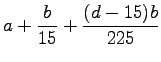
Vehicles are moving on a road at the rate of 500 vehicle/hour, at a velocity of
15 km/hr. Find the equation for marginal cost.
Private cost of the trip is given by,
It is given that Flow rate, q=500 veh/hr.
Speed of the vehicle is given by,
Marginal Cost is given by,
Therefore, the equation of marginal cost for the vehicles moving on the given
congested road is given by
![$ M= a+(b/15)+[(d-15)*b/225]$](img39.png)
|
|
| | |
|
|
|