| |
| | |
|
Congestion has to be measured or quantified in order to suggest suitable
counter measures and their evaluation.
Congestion information can be used in a variety of policy, planning and
operational situations.
It may be used by public agencies in assessing facility or system adequacy,
identifying problems, calibrating models, developing and assessing
improvements, formulating programs policies and priorities.
It may be used by private sector in making locational or investment decisions.
It may be used by general public and media in assessing traveler's
satisfaction.
Performance measure of a congested roadway can be done using the following four
components:
- Duration,
- Extent,
- Intensity, and
- Reliability.
Duration of congestion is the amount of time the congestion affects the travel
system.
The peak hour has now extended to peak period in many corridors.
Measures that can quantify congestion include:
- Amount of time during the day that the travel rate indicates congested
travel on a system element or entire system.
- Amount of time during the day that traffic density measurement techniques
(detectors, aerial surveillance, etc.) indicate congested travel.
Duration of congestion is the sum of length of each analysis sub period for
which the demand exceeds capacity.
This component measures the performance of a particular road in handling
traffic efficiently i,e.,with the increase in the duration of congestion,
poorer will be the performance of the transportation system.
The maximum duration on any link indicates the amount of time before congestion
is completely cleared from the corridor.
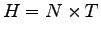
Duration of congestion can be computed for a corridor using the following
equation:
For corridor analysis,
 |
(1) |
where,  is the duration of congestion (hours), is the duration of congestion (hours),  is the number of analysis
sub periods for which is the number of analysis
sub periods for which  , and , and  is the duration of analysis
sub-period (hours).
For area wide analysis, is the duration of analysis
sub-period (hours).
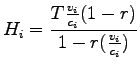
For area wide analysis,
 |
(2) |
where,  is the duration of congestion for link is the duration of congestion for link  (hours), is the
duration of analysis period (hours), (hours), is the
duration of analysis period (hours),  is the ratio of peak demand to peak
demand rate, is the ratio of peak demand to peak
demand rate,  is the vehicle demand on link (veh/hr), and is the vehicle demand on link (veh/hr), and  is the
capacity of link (veh/hr). is the
capacity of link (veh/hr).
|
|
| | |
|
|
|


