| |
| | |
|
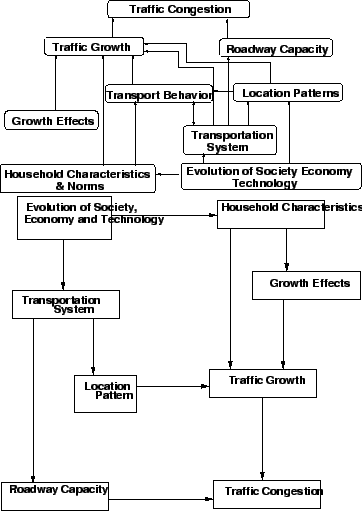
The flow chart in Fig. 1 shows how traffic congestion is
generated in a transportation system.
With the evolution of society, economy and technology, the household
characteristics as well as the transportation system gets affected.
The change in transport system causes a change in transport behaviour and
locational pattern of the system.
The change in household characteristics, transport behaviour, locational
pattern, and other growth effects result in the growth of traffic.
But the change or improvement in road capacity is only as the result of change
in the transportation system and hence finally a situation arises where the
traffic demand is greater than the capacity of the roadway.
This situation is called traffic congestion.
Figure 1:
Generation of traffic congestion
 |
Congestion has a large number of ill effects on drivers, environment, health
and the economy in the following ways.
- Drivers who encounter unexpected traffic may be late for work and other
appointments causing a loss in productivity and their valuable time.
- Since congestion leads to increase in travel time i,e.,vehicles are made
to travel for more time than required which consumes large amount of fuel there
by causing fuel loss and economic loss to the drivers.
- One of the most harmful effects of traffic congestion is its impact on
the environment.
Despite the growing number of vehicles ,cars stopped in traffic still produces
a large volume of harmful carbon emissions .
Increase in pollutants (because of both the additional fuel burned and more
toxic gases produced while internal combustion engines are in idle or in
stop-and-go traffic)
- Drivers who become impatient may be more likely to drive aggressively and
dangerously and leads to high potential for traffic accidents
- Negative impact on people's psychological state, which may affect
productivity at work and personal relationships
- Slow and inefficient emergency response and delivery services
- Decrease in road surface lifetime: When a vehicle moves over the surface,
the areas of contact (where the vehicles' tyres touch the road) are deflected
downwards under the weight of the vehicle and as the vehicle moves forward, the
deflection corrects itself to its original position.
- Vehicle maintenance costs; 'Wear and tear' on mechanical components of
vehicles such as the clutch and brakes is also considerably increased under
stop-start driving conditions and hence increasing the vehicle maintenance
costs.
- One beneficial effect of traffic congestion is its ability to encourage
drivers to consider other transportation options like a subway, light rail or
bus service.
These options reduce traffic on the roads ,thereby reducing congestion and
environmental pollution.
The summation of all these effects yields a considerable loss for the society
and the economy of an urban area
A system is said to be congested when the demand exceeds the capacity of the
section.
Traffic congestion can be defined in the following two ways:
- Congestion is the travel time or delay in excess of that normally
incurred under light or free flow traffic condition.
- Unacceptable congestion is travel time or delay in excess of agreed norm
which may vary by type of transport facility, travel mode, geographical
location, and time of the day.
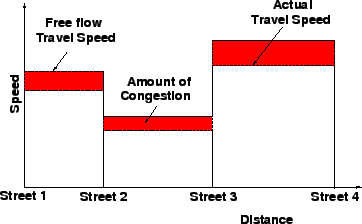
Fig. 2 shows the definition of congestion.
The solid line represents the travel speed under free-flow conditions and the
dotted line represents the actual travel speed.
During congestion, the vehicles will be travelling at a speed less than their
free flow speed.
The shaded area in between these two lines represents the amount of congestion.
Figure 2:
Definition of congestion
 |
Traffic congestion may be of two types:
- Recurrent Congestion: Recurrent congestion generally occurs at
the same place, at the same time every weekday or weekend day.
This is generally the consequence of factors that act regularly or periodically
on the transportation system such as daily commuting or weekend trips.
Recurrent congestion is predictable and typically occurs during peak hours.
It displays a large degree of randomness in terms of duration and severity.
- Non-Recurrent congestion: Non-Recurrent congestion is the
effect of unexpected ,unplanned large events( road woks, accidents, special
events and so on) that affect transportation system more or less randomly and
as such,cannot be easily predicted.
|
|
| | |
|
|
|


