| |
| | |
|
Extent of congestion is described by estimating the number of people or
vehicles affected by congestion and by the geographic distribution of
congestion.
These measures include:
- Number or percentage of trips affected by congestion.
- Number or percentage of person or vehicle meters affected by congestion.
- Percentage of the system affected by congestion.
Performance measures of extent of congestion can be computed from sum of length
of queuing on each segment.
Segments in which queue overflows the capacity are also identified.
This is useful for ramp metering analysis.
To compute queue length, average density of vehicles in a queue need to be
known.
The default values suggested by HCM 2000 are given in Table 1.
Table 1:
Queue density default values
| Subsystem |
Storage density |
Spacing |
| |
(veh/km/lane) |
(m) |
| Free-way |
75 |
13.3 |
| Two lane highway |
130 |
7.5 |
| Urban street |
130 |
7.5 |
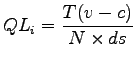
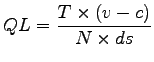
Queue length can be found out using the equation:
 |
(1) |
where;  is the queue length (meter), is the queue length (meter),  is the segment demand
(veh/hour), is the segment demand
(veh/hour),  is the segment capacity (veh/hour), is the segment capacity (veh/hour),  is the number of lanes, is the number of lanes,
 is the storage density (veh/meter/lane), and is the storage density (veh/meter/lane), and  is the duration of
analysis period (hour).
If is the duration of
analysis period (hour).
If  , ,  =0 The equation for queue length is similar for both corridor
and area-wide analysis.
Consider a road segment of 6 lanes with a capacity of 2400 veh/hr/lane. It is
observed that the storage density is 75 veh/meter and the segment demand is
found to be 2800 veh/hr/lane.
Given that the duration of analysis sub period is 2 hrs calculate the queue
length that is formed due to congestion.
The queue length of a particular road segment is given by, =0 The equation for queue length is similar for both corridor
and area-wide analysis.
Consider a road segment of 6 lanes with a capacity of 2400 veh/hr/lane. It is
observed that the storage density is 75 veh/meter and the segment demand is
found to be 2800 veh/hr/lane.
Given that the duration of analysis sub period is 2 hrs calculate the queue
length that is formed due to congestion.
The queue length of a particular road segment is given by,
 |
(2) |
It is given that Number of lanes, N=6,
Duration of analysis sub period, T= 2 hrs,
Segment Capacity=c=2400 veh/hr/lane,
Segment Demand=v=2800 veh/hr/lane,
Storage Density=ds=75 veh/meter.
Now,the queue length can be calculated by using the above formula as follows:
 Therefore, the extent of congestion in terms of queue length is 10.667mts
Intensity of congestion marks the severity of congestion.
It is used to differentiate between levels of congestion on transport system
and to define total amount of congestion.
It is measured in terms of:
Therefore, the extent of congestion in terms of queue length is 10.667mts
Intensity of congestion marks the severity of congestion.
It is used to differentiate between levels of congestion on transport system
and to define total amount of congestion.
It is measured in terms of:
- Delay in person hours or vehicle hours;
- Average speed of roadway, corridor, or network;
- Delay per capita or per vehicle travelling in the corridor, or per person
or per vehicle affected by congestion;
- Relative delay rate (relative rate of time lost for vehicles);
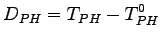
Intensity in terms of delay is given by,
 |
(3) |
where,  is the person hours of delay, is the person hours of delay,  is the person hours of
travel under actual conditions, and is the person hours of
travel under actual conditions, and  is the person hours of travel
under free flow conditions.
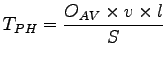
The is given by: is the person hours of travel
under free flow conditions.
The is given by:
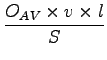
 |
(4) |
where,  is the average vehicle occupancy, is the vehicle demand
(veh), is the average vehicle occupancy, is the vehicle demand
(veh),  is the length of link (km), and is the length of link (km), and  is the mean speed of link
(km/hr). The is given by: is the mean speed of link
(km/hr). The is given by:
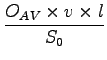
 |
(5) |
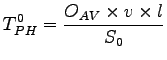
where, is the average vehicle occupancy, is the vehicle demand
(veh), is the length of link (km), and  is the free flow speed on the
link (km/hr)
On a 2.8 km long link of road, it was found that the demand is 1000
Vehicles/hour mean speed of the link is 12 km/hr, and the free flow speed is
27 km/hr.
Assuming that the average vehicle occupancy is 1.2 person/vehicle, calculate
the congestion intensity in terms of total person hours of delay. is the free flow speed on the
link (km/hr)
On a 2.8 km long link of road, it was found that the demand is 1000
Vehicles/hour mean speed of the link is 12 km/hr, and the free flow speed is
27 km/hr.
Assuming that the average vehicle occupancy is 1.2 person/vehicle, calculate
the congestion intensity in terms of total person hours of delay.
Given data:
Length of the link=l=2.8 km,
Vehicle demand=v=1000 veh,
Mean Speed of the link=S=12 km/hr,
Free flow speed on the link=So=27 km/hr, and
Average Vehicle Occupancy=AVO=1.2 person/veh.
Person hours of delay is given as
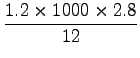
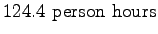
Person hours of travel under actual conditions,
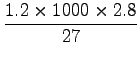
Person hours of travel under free flow conditions,
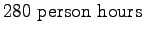
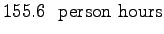
Therefore, person hours of delay can be calculated as follows,,
Hence, the intensity of congestion is determined in terms of person hours of
delay as 156 person hours.
|
|
| | |
|
|
|