| |
| | |
|
The variation in extent and duration of congestion indicates different problems
requiring different solutions.
Small delay and extent indicates limited problem, small delay for large extent
indicates general congestion, great delay for small extent indicates critical
links and great delay for large extent indicates critical system-wide problem.
Fig. 1 also illustrates the relationship between duration,
extent and intensity
The extent of congestion is seen on the x-axis, the duration on the y-axis. The
intensity is shown in the shading. Based on the extent and duration the
congestion can be classified into four types as shown in
Fig.2.
Figure 1:
Intensity of congestion-relation between duration and distance
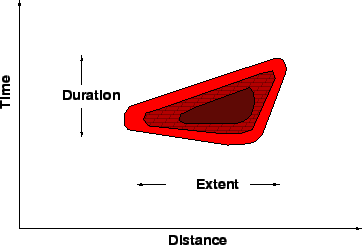 |
Fig.1 indicates a time distance graph with the shaded area
indicating congestion in individual road segments for discrete time periods.
The figure shows the relationship between duration, extent, and intensity.
Figure 2:
Intensity of congestion-Relation between extent and duration of delay
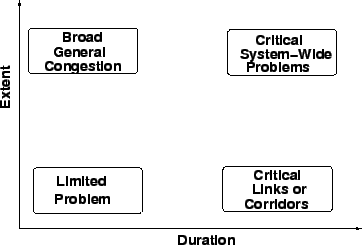 |
The product of extent and duration indicates the intensity, or magnitude of the
congestion problem.
Reliability is a measure of a driver‟s ability to accurately predict and plan
for a certain travel time.
The more unexpected events that occur on a roadway, the less reliable it is.
Non recurrent congestion has a bigger impact on the reliability of the roadway
relative to concurrent congestion.
In other words, Travel-time reliability is defined as the level of consistency
in travel conditions over time and is measured by describing the distribution
of travel times that occur over a substantial period of time.
Reliability is an important component of roadway performance and perhaps more
importantly, of motorist‟s perceptions of roadway performance.
The importance of measuring and managing reliability in reducing congestion is
explained as follows.
- Motorists have less tolerance for unexpected delay than for expected
delay
- Cost associated with unreliable travel
- Reliability is a valued service in other industries and utilities
Therefore, it is clear that reliability is the impact of non-recurrent
congestion on transport system and it can be expressed as average travel rate
or speed ± standard deviation or delay ± standard deviation.
|
|
| | |
|
|
|


