| |
| | |
|
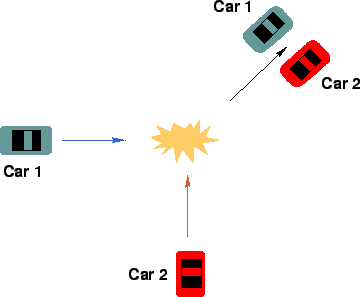
Angular collision occurs when two vehicles coming at right angles collies with each other and bifurcates in different direction.
The direction of the vehicles after collision in this case depends on the initial speeds of the two vehicles and their weights.
One general case is that two vehicles coming from south and west direction after colliding move in its resultant direction as shown in
Figure 1.
Figure 1:
Angular collision of two vehicles resulting in movement in resultant
direction
 |
The mass of the car 1 is  kg and the car 2 is kg and the car 2 is  kg and the initial velocity is kg and the initial velocity is  m/s and m/s and  m/s respectively.
So as the momentum is the product of mass and velocity.
The momentum of the car 1 and car 2 is m/s respectively.
So as the momentum is the product of mass and velocity.
The momentum of the car 1 and car 2 is  kgm/s and kgm/s and  kgm/s respectively.
By the law of conservation of momentum the final momentum should be equal to the initial momentum.
But as the car are approaching each other at an angle the final momentum should not be just mere summation of both the momentum but the resultant of the two,
Resultant momentum = kgm/s respectively.
By the law of conservation of momentum the final momentum should be equal to the initial momentum.
But as the car are approaching each other at an angle the final momentum should not be just mere summation of both the momentum but the resultant of the two,
Resultant momentum =
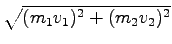 kg m/s.
The angle at which they are bifurcated after collision is given by kg m/s.
The angle at which they are bifurcated after collision is given by
 where h is the hypotenuse and b is the base.
Therefore, the cars are inclined at an angle.
Inclined at an angle = where h is the hypotenuse and b is the base.
Therefore, the cars are inclined at an angle.
Inclined at an angle =
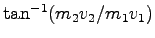 .
Now, since the mass of the two vehicles are same the final velocity will
proportionally be changed.
The general schematic diagrams of collision are shown in
Figs. 2 to
4. .
Now, since the mass of the two vehicles are same the final velocity will
proportionally be changed.
The general schematic diagrams of collision are shown in
Figs. 2 to
4.
Figure 2:
After collision movement of car 1 north of west and car 2 in east of
north
![\begin{figure}\centerline{\epsfig{file=qfAcciMovementAfterCollision1.eps,width=8cm}}
% (Source: [1])}
\end{figure}](img11.png) |
Figure 3:
After collision movement of car 1 and car 2 in north of east
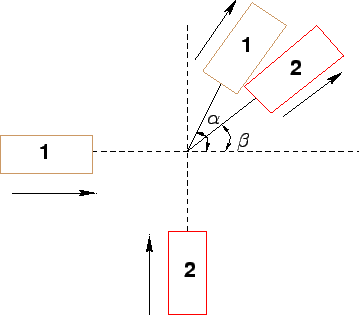 |
Figure 4:
After collision movement of car 1 north of east and car 2 in south of
east
![\begin{figure}\centerline{\epsfig{file=qfAcciMovementAfterCollision3.eps,width=8cm}}
% (Source: [7])}
\end{figure}](img13.png) |
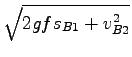
Vehicle A is approaching from west and vehicle B from south.
After collision A skids  north of east and B skids north of east and B skids  south of east as shown in Figure 4.
Skid distance before collision for A is 18 m and B is 26 m.
The skid distances after collision are 30m and 15 m respectively.
Weight of A and B are 4500 and 6000 respectively.
Skid resistance of pavement is 0.55 m.
Determine the pre-collision speed.
Let:
initial speed is south of east as shown in Figure 4.
Skid distance before collision for A is 18 m and B is 26 m.
The skid distances after collision are 30m and 15 m respectively.
Weight of A and B are 4500 and 6000 respectively.
Skid resistance of pavement is 0.55 m.
Determine the pre-collision speed.
Let:
initial speed is  and and  ,
speed after skidding before collision is ,
speed after skidding before collision is  and and  ,
speed of both the vehicles A and B after collision is ,
speed of both the vehicles A and B after collision is  and and  ,
final speed is ,
final speed is  and and  is 0,
initial skid distance for A and B is is 0,
initial skid distance for A and B is  and and  ,
final skid distance for A and B is ,
final skid distance for A and B is  and and  , and
weight of vehicle A is , and
weight of vehicle A is  and Weight of vehicle B is and Weight of vehicle B is  . .
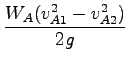
- After collision:
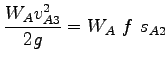
Loss in kinetic energy of each cars= Work done against skid resistance (can be
obtained from equation.
![[*]](file:/usr/local/share/lib/latex2html/icons/crossref.png) ) )
As = 0, it is not considered in the above equation
Similarly, we calculate using the similar formula and using
- At collision:
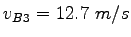
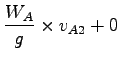
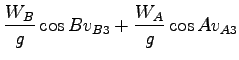
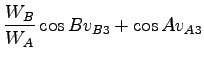
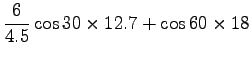
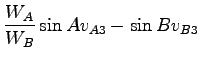
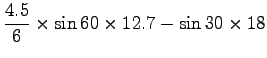
Momentum before impact is momentum after impact (resolving along west-east
direction and using equation. )
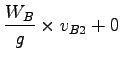
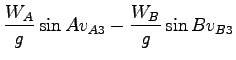
Resolving the moments along south- north direction
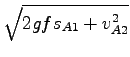
- Before collision:
Loss in kinetic energy of each cars= Work done against skid resistance (can be
obtained from equation. )
Similarly, using the same equation and using
Answer: The pre-collision speed of the vehicle A (approaching from west) is = 99 km/hr and vehicle B (approaching from south) is = 63.26 km/hr.
|
|
| | |
|
|
|