| |
| | |
|
The purpose is to find the possible causes of accident related to driver,
vehicle, and roadway.
Accident analyses are made to develop information such as:
- Driver and Pedestrian - Accident occurrence by age groups and
relationships of accidents to physical capacities and to psychological test
results.
- Vehicle - Accident occurrence related to characteristic of vehicle, severity, location and extent of damage related to vehicles.
- Roadway conditions - Relationships of accident occurrence and
severity to characteristics of the roadway and roadway condition and relative
values of changes related to roadways.
It is important to compute accident rate which reflect accident involvement by
type of highway.
These rates provide a means of comparing the relative safety of different
highway and street system and traffic controls.
Another is accident involvement by the type of drivers and vehicles associated
with accidents.
- Accident Rate per Kilometer :
On this basis the total accident hazard is expressed as the number of accidents
of all types per km of each highway and street classification.
 |
(1) |
where,  = total accident rate per km for one year, = total accident rate per km for one year,  = total number of accident occurring in one year, = total number of accident occurring in one year,  = length of control section in kms = length of control section in kms
- Accident involvement Rate :
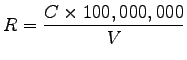
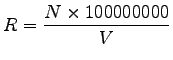
It is expressed as numbers of drivers of vehicles with certain characteristics
who were involved in accidents per 100 million vehicle-kms of travel.
 |
(2) |
where, = accident involvement per 100 million vehicle-kms of travel,  = total number of drivers of vehicles involved in accidents during the period of investigation and = total number of drivers of vehicles involved in accidents during the period of investigation and  = vehicle-kms of travel on road section during the period of investigation = vehicle-kms of travel on road section during the period of investigation
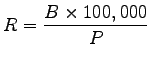
- Death rate based on population :
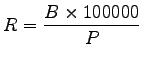
The traffic hazard to life in a community is expressed as the number of traffic
fatalities per 100,000 populations.
This rate reflects the accident exposure for entire area.
 |
(3) |
where, = death rate per 100,000 population,  = total number of traffic death in one year and = total number of traffic death in one year and  = population of area = population of area
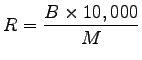
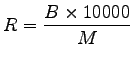
- Death rate based on registration :
The traffic hazard to life in a community can also be expressed as the number of
traffic fatalities per 10,000 vehicles registered.
This rate reflects the accident exposure for entire area and is similar to death
rate based on population.
 |
(4) |
where, = death rate per 10,000 vehicles registered, = total number of traffic death in one year and  = number of motor vehicles registered in the area = number of motor vehicles registered in the area
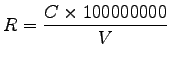
- Accident Rate based on vehicle-kms of travel :
The accident hazard is expressed as the number of accidents per 100 million
vehicle km of travel.
The true exposure to accident is nearly approximated by the miles of travel of
the motor vehicle than the population or registration.
 |
(5) |
where, = accident rate per 100 million vehicle kms of travel,  = number of total accidents in one year and = vehicle kms of travel in one year = number of total accidents in one year and = vehicle kms of travel in one year
The Motor vehicle consumption in a city is 5.082 million liters, there were 3114 motor vehicle fatalities, 355,799 motor vehicle injuries, 6,721,049 motor vehicle registrations and an estimated population of 18,190,238.
Kilometer of travel per liter of fuel is 12.42 km/liter.
Calculate registration death rate, population death rate and accident rate per
vehicle km.
Approximate vehicle kms of travel = Total consumption o fuel  kilometer of
travel per liter of fuel =5.08 kilometer of
travel per liter of fuel =5.08  12.42 = 63.1
km. 12.42 = 63.1
km.
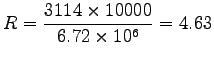
- Registration death rate can be obtained from the equation
Here, R is the death rate per 10,000 vehicles registered,
(Motor vehicle fatalities) is 3114,
(Motor vehicle registered) is 6.72  .
Hence, .
Hence,
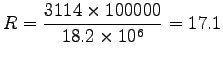
- Population Death Rate can be obtained from
the equation.
Here, R is the death rate per 100,000 population,
(Motor vehicle fatalities) is 3114,
(Estimated population) is= 18.2 .
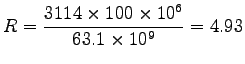
- Accident rate per vehicle kms of travel can be obtained from the equation below as:
Here, R is the accident rate per 100 million vehicle kms of travel,
(total accident same as vehicle fatalities) is 3114,
(vehicle kms of travel) is 63.1 .
|
|
| | |
|
|
|