Applying principle of conservation of energy or conservation of momentum also
the initial speed of the vehicle can be computed if the skid marks are known.
It is based on the concept that there is reduction in kinetic energy with the
work done against the skid resistance.
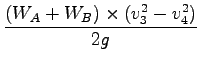
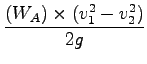
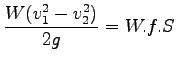
So if the vehicle of weight  slow down from speed slow down from speed  to to  , then the
loss in kinetic energy will be equal to the work done against skid resistance,
where work done is weight of the vehicle multiplied by the skid distance and the
skid resistance coefficient. , then the
loss in kinetic energy will be equal to the work done against skid resistance,
where work done is weight of the vehicle multiplied by the skid distance and the
skid resistance coefficient.
 |
(1) |
where,  is the skid resistance coefficient and is the skid resistance coefficient and  is the skid distance.
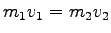
It also follows the law of conservation of momentum ( is the skid distance.
It also follows the law of conservation of momentum ( , are the mass
and velocity of first vehicle colliding with another vehicle of mass and
velocity , are the mass
and velocity of first vehicle colliding with another vehicle of mass and
velocity  , respectively) , respectively)
 |
(2) |
A vehicle of 2000 kg skids a distance of 36 m before colliding with a stationary vehicle of 1500 kg weight.
After collision both vehicle skid a distance of 14 m.
Assuming coefficient of friction 0.5, determine the initial speed of the vehicle.
Solution:
Let the weight of the moving vehicle is  , let the weight of the stationary
vehicle is , let the weight of the stationary
vehicle is  , skid distance before and after collision is , skid distance before and after collision is  and and  respectively, initial speed is , speed after applying brakes before
collision is and the speed of both the vehicles
respectively, initial speed is , speed after applying brakes before
collision is and the speed of both the vehicles  and and  after
collision is after
collision is  , and the final speed , and the final speed  is 0.
Then: is 0.
Then:
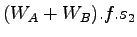
- After collision:
Loss in kinetic energy of both cars = Work done against skid resistance (can be
obtained from equation mentioned below).
Substituting the values we obtain .
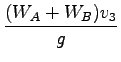
- At collision:
Momentum before impact = momentum after impact (can be obtained from
equation. 2)
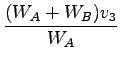
- Before collision (can be obtained from
equation. 1):
Loss in kinetic energy of moving vehicle = work done against braking force in
reducing the speed
Ans: The pre-collision speed of the moving vehicle is 100 kmph.
|