Accident reconstruction deals with representing the accidents occurred in
schematic diagram to determine the pre-collision speed which helps in regulating
or enforcing rules to control or check movement of vehicles on road at high
speed.
The following data are required to determine the pre-collision speed:
- Mass of the vehicle
- Velocities after collision
- Path of each vehicle as it approaches collision point
Below in Figure 1 a schematic diagram of collision of two
vehicles is shown that occur during turning movements.
This diagram is also known as collision diagram.
Each collision is represented by a set of arrows to show the direction of before
and after movement.
The collision diagram provides a powerful visual record of accident occurrence
over a significant period of time.
Figure 1:
Collision diagram of two vehicles
![\begin{figure}\centerline{\epsfig{file=qfAcciCollisionDiag.eps,width=8cm}}
% (Source: [3])}
\end{figure}](img1.png) |
The collision may be of two types collinear impact or angular collision.
Below each of them are described in detail.
Collinear impact can be again divided into two types :
- Rear end collision
- Head-on collision.
It can be determined by two theories:
- Poisson Impact Theory
- Energy Theory
Poisson impact theory, divides the impact in two parts - compression and
restitution.
The Figure 2 shows two vehicles travelling at an
initial speed of  and and  collide and obtain a uniform speed say collide and obtain a uniform speed say  at the compression stage.
And after the compression stage is over the final speed is at the compression stage.
And after the compression stage is over the final speed is  and and  .
The compression phase is cited by the deformation of the cars. .
The compression phase is cited by the deformation of the cars.
Figure 2:
Compression Phase
![\begin{figure}\centerline{\epsfig{file=qfAcciCompressionPhase.eps,width=8cm}}
% (Source: [7])}
\end{figure}](img7.png) |
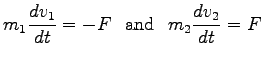
From the Newton’s law  , ,
 |
(1) |
where,  and and  are the masses of the cars and are the masses of the cars and  is the contact force.
We know that every reaction has equal and opposite action.
So as the rear vehicle pushes the vehicle ahead with force .
The vehicle ahead will also push the rear vehicle with same magnitude of force but has different direction.
The action force is represented by , whereas the reaction force is represented by is the contact force.
We know that every reaction has equal and opposite action.
So as the rear vehicle pushes the vehicle ahead with force .
The vehicle ahead will also push the rear vehicle with same magnitude of force but has different direction.
The action force is represented by , whereas the reaction force is represented by  as shown in Figure 3. as shown in Figure 3.
Figure 3:
Force applied on each vehicle
![\begin{figure}\centerline{\epsfig{file=qfAcciForceApplied.eps,width=8cm}}
% (Source: [7])}
\end{figure}](img14.png) |
In the compression phase cars are deformed.
The compression phase terminates when the cars have equal velocity.
Thus the cars obtain equal velocity which generates the following equation:
 |
(2) |
where,
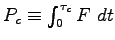 which is the compression impulse
and which is the compression impulse
and  is the compression time.
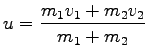
Thus, the velocity after collision is obtained as: is the compression time.
Thus, the velocity after collision is obtained as:
 |
(3) |
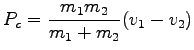
The compression impulse is given by:
 |
(4) |
In the restitution phase the elastic part of internal energy is released
where,
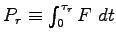 is the restitution impulse
and is the restitution impulse
and  is the restitution time.
According to Poisson’s hypothesis restitution impulse is proportional to
compression impulse is the restitution time.
According to Poisson’s hypothesis restitution impulse is proportional to
compression impulse
 |
(7) |
Restitution impulse  is given by: is given by:
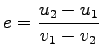 |
(8) |
The total impulse is
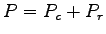
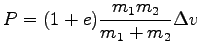 |
(9) |
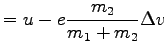
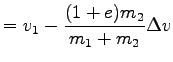
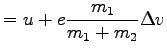
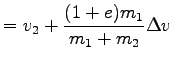
The post impact velocities are given by:
where
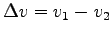 .
But we are required to determine the pre-collision speed according to which the safety on the road can be designed.
So we will determine and from the given value of and .
Two vehicles travelling in the same lane have masses 3000 kg and 2500 kg.
The velocity of rear vehicles after striking the leader vehicle is 25 kmph and
the velocity of leader vehicle is 56 kmph.
The coefficient of restitution of the two vehicle system is assumed to be 0.6.
Determine the pre-collision speed of the two vehicles.
Given that the: mass of the first vehicle () = 3000 kg,
mass of the second vehicle () = 2500 kg,
final speed of the rear vehicle () = 25 kmph, and
final speed of the leader vehicle () = 56 kmph.
Let initial speed of the rear vehicle be , and
let initial speed of the leader vehicle be . .
But we are required to determine the pre-collision speed according to which the safety on the road can be designed.
So we will determine and from the given value of and .
Two vehicles travelling in the same lane have masses 3000 kg and 2500 kg.
The velocity of rear vehicles after striking the leader vehicle is 25 kmph and
the velocity of leader vehicle is 56 kmph.
The coefficient of restitution of the two vehicle system is assumed to be 0.6.
Determine the pre-collision speed of the two vehicles.
Given that the: mass of the first vehicle () = 3000 kg,
mass of the second vehicle () = 2500 kg,
final speed of the rear vehicle () = 25 kmph, and
final speed of the leader vehicle () = 56 kmph.
Let initial speed of the rear vehicle be , and
let initial speed of the leader vehicle be .
Step 1:
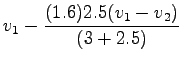
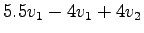
From equation. 10,
Step 2:
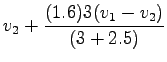
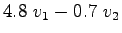
From equation. 11,
Step 3:
Solving equations. 12 and 13,
We get the pre collision speed of two vehicles as:
= 73 kmph, and
= 62 kmph.
Step 4:
Initial speed of the rear vehicle, = 73 kmph, and the initial speed of
leader vehicle, = 62 kmph.
Thus from the result we can infer that the follower vehicle was travelling at
quite high speed which may have resulted in the collision.
The solution to the problem may be speed restriction in that particular stretch
of road where accident occurred.
|