| |
| | |
|
Information to guide, regulate, or warn the road user may also be conveyed by
inscription of word message on road surface.
Characters for word messages are usually capital letters.
The legends should be as brief as possible and shall not consist of more than
three words for any message.
Word messages require more and important time to read and comprehend than other
road markings.
Therefore, only few and important ones are usually adopted.
Some of the examples of word messages are STOP, SLOW, SCHOOL, RIGHT TUN ONLY
etc.
The character of a road message is also elongated so that driver looking at the
road surface at a low angle can also read them easily.
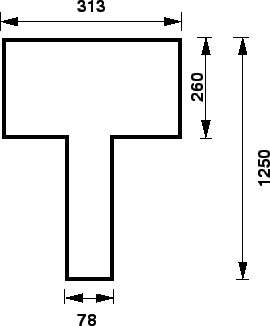
The dimensioning of a typical alphabet is shown in figure 1.
Figure 1:
Typical dimension of the character T used in road marking
 |
The marking of the parking space limits on urban roads promotes more efficient
use of the parking spaces and tends to prevent encroachment on places like bus
stops, fire hydrant zones etc. where parking is undesirable.
Such parking space limitations should be indicated with markings that are solid
white lines 100 mm wide.
Words TAXI, CARS, SCOOTERS etc. may also be written if the parking area is
specific for any particular type of vehicle.
To indicate parking restriction, kerb or carriage way marking of continuous
yellow line 100 mm wide covering the top of kerb or carriageway close to it may
be used.
Wherever there is a change in the width of the road, or any hazardous location
in the road, the driver should be warned about this situation with the help of
suitable road markings.
Road markings showing the width transition in the carriageway should be of 100
mm width.
Converging lines shall be 150 mm wide and shall have a taper length of not less
than twenty times the off-set distance.
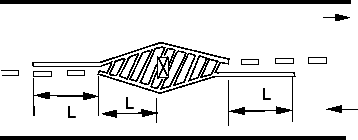
Typical carriageway markings showing transition from wider to narrower sections
and vice-versa is shown in figure 2.
In the figure, the driver is warned about the position of the pier through
proper road markings.
Figure 2:
Approach marking for obstructions on the road way
 |
|
|
| | |
|
|
|


