|
Edge lines indicate edges of rural roads which have no kerbs to delineate the
limits up to which the driver can safely venture.
They should be at least 150 mm from the actual edge of the pavement.
They are painted in yellow or white.
All the lines should be preferably light reflective, so that they will be
visible during night also.
Improved night visibility may also be obtained by the use of minute glass beads
embedded in the pavement marking materials to produce a retroreflective
surface.
Transverse markings are marked across the direction of traffic.
They are marked at intersections etc.
The site conditions play a very important role.
The type of road marking for a particular intersection depends on several
variables such as speed characteristics of traffic, availability of space etc.
Stop line markings, markings for pedestrian crossing, direction arrows, etc.
are some of the markings on approaches to intersections.
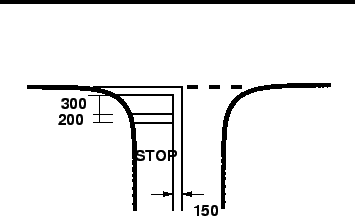
Stop line indicates the position beyond which the vehicles should not proceed
when required to stop by control devices like signals or by traffic police.
They should be placed either parallel to the intersecting roadway or at right
angles to the direction of approaching vehicles.
An example for a stop line marking is shown in figure 1.
Figure 1:
Stop line marking near an intersection
 |
Pedestrian crossings are provided at places where the conflict between
vehicular and pedestrian traffic is severe.
The site should be selected that there is less inconvenience to the pedestrians
and also the vehicles are not interrupted too much.
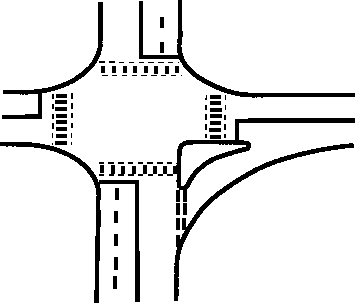
At intersections, the pedestrian crossings should be preceded by a stop line at
a distance of 2 to 3m for unsignalized intersections and at a distance of one
meter for signalized intersections.
Most commonly used pattern for pedestrian crossing is Zebra crossing consisting
of equally spaced white strips of 500 mm wide.
A typical example of an intersection illustrating pedestrian crossings is shown
in figure 2.
Figure 2:
Pedestrian marking near an intersection
 |
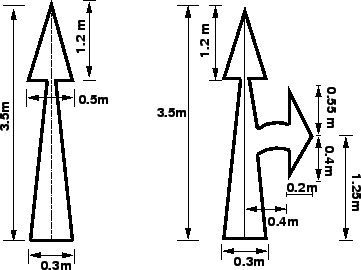
In addition to the warning lines on approaching lanes, directional arrows
should be used to guide the drivers in advance over the correct lane to be
taken while approaching busy intersections.
Because of the low angle at which the markings are viewed by the drivers, the
arrows should be elongated in the direction of traffic for adequate visibility.
The dimensions of these arrows are also very important.
A typical example of a directional arrow is shown in figure 3.
Figure 3:
Directional arrow marking
 |
|


