| |
| | |
|
Center line separates the opposing streams of traffic and facilitates their
movements.
Usually no center line is provided for roads having width less than 5 m and for
roads having more than four lanes.
The center line may be marked with either single broken line, single solid
line, double broken line, or double solid line depending upon the road and
traffic requirements.
On urban roads with less than four lanes, the center line may be single broken
line segments of 3 m long and 150 mm wide.
The broken lines are placed with 4.5 m gaps (figure 1).
Figure 1:
Center line marking for a two lane road
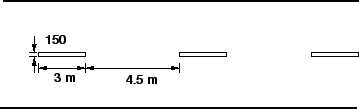 |
On curves and near intersections, gap shall be reduced to 3 meters.
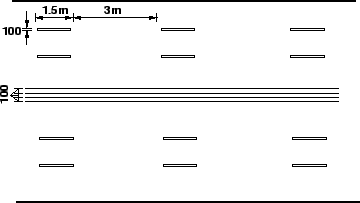
On undivided urban roads with at least two traffic lanes in each direction, the
center line marking may be a single solid line of 150 mm wide as in figure
2, or double solid line of 100 mm wide separated by a space of 100 mm
as shown in figure 3.
Figure 2:
Center line and lane marking for a four lane road
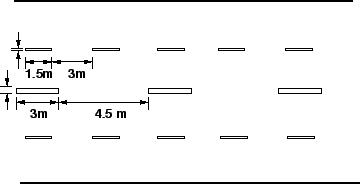 |
Figure 3:
Double solid line for a two lane road
 |
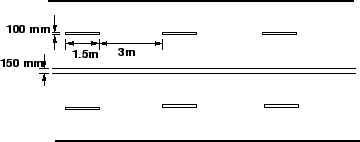
The center barrier line marking for four lane road is shown in figure
4.
Figure 4:
Center barrier line marking for four lane road
 |
|
|
| | |
|
|
|


