No passing zones are established on summit curves, horizontal curves, and on
two lane and three lane highways where overtaking maneuvers are prohibited
because of low sight distance.
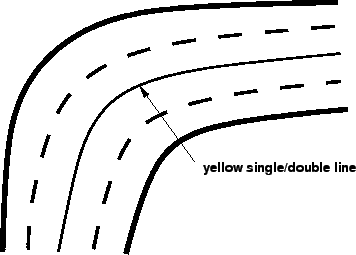
It may be marked by a solid yellow line along the center or a double yellow
line.
In the case of a double yellow line, the left hand element may be a solid
barrier line, the right hand may be a either a broken line or a solid line .
These solid lines are also called barrier lines.
When a solid line is to the right of the broken line, the passing restriction
shall apply only to the opposing traffic.
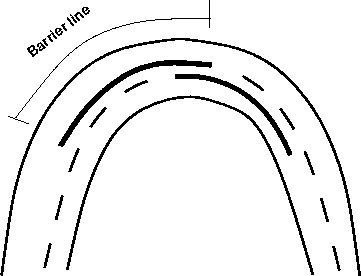
Some typical examples are shown in figure 1 and figure 2.
Figure 1:
Barrier line marking for a four lane road
Figure 2:
No passing zone marking at horizontal curves
In the latter case, the no passing zone is staggered for each direction.
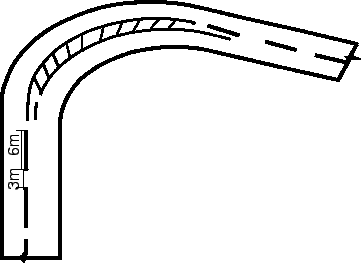
Warning lines warn the drivers about the obstruction approaches.
They are marked on horizontal and vertical curves where the visibility is
greater than prohibitory criteria specified for no overtaking zones.
They are broken lines with 6 m length and 3 m gap.
A minimum of seven line segments should be provided.
A typical example is shown in figure 3
Figure 3:
Warning line marking for a two lane road