| |
| | |
|
Physical obstructions in a carriageway like traffic island or obstructions near
carriageway like signal posts, pier etc. cause serious hazard to the flow of
traffic and should be adequately marked.
They may be marked on the objects adjacent to the carriageway.
The obstructions within the carriageway such as traffic islands, raised
medians, etc. may be marked by not less than five alternate black and yellow
stripes.
The stripes should slope forward at an angle of 45 with respect to the
direction of traffic.
These stripes shall be uniform and should not be less than 100 m wide so as to
provide sufficient visibility.
Sometimes objects adjacent to the carriageway may pose some obstructions to the
flow of traffic.
Objects such as subway piers and abutments, culvert head walls etc. are some
examples for such obstructions.
They should be marked with alternate black and white stripes at a forward angle
of 45 with respect to the direction of traffic.
Poles close to the carriageway should be painted in alternate black and white
up to a height of 1.25 m above the road level.
Other objects such as guard stones, drums, guard rails etc. where chances of
vehicles hitting them are only when vehicle runs off the carriageway should be
painted in solid white.
Kerbs of all islands located in the line of traffic flow shall be painted with
either alternating black and white stripes of 500 mm wide or chequered black
and white stripes of same width.
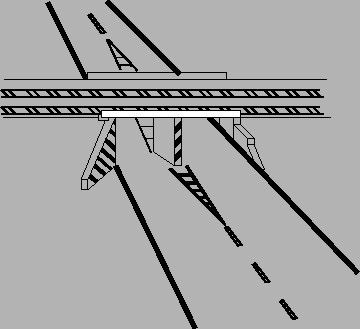
The object marking for central pier and side walls of an underpass is
illustrated in figure 1. with respect to the
direction of traffic.
These stripes shall be uniform and should not be less than 100 m wide so as to
provide sufficient visibility.
Sometimes objects adjacent to the carriageway may pose some obstructions to the
flow of traffic.
Objects such as subway piers and abutments, culvert head walls etc. are some
examples for such obstructions.
They should be marked with alternate black and white stripes at a forward angle
of 45 with respect to the direction of traffic.
Poles close to the carriageway should be painted in alternate black and white
up to a height of 1.25 m above the road level.
Other objects such as guard stones, drums, guard rails etc. where chances of
vehicles hitting them are only when vehicle runs off the carriageway should be
painted in solid white.
Kerbs of all islands located in the line of traffic flow shall be painted with
either alternating black and white stripes of 500 mm wide or chequered black
and white stripes of same width.
The object marking for central pier and side walls of an underpass is
illustrated in figure 1.
Figure 1:
Marking for objects adjacent to the road way
 |
|
|
| | |
|
|
|


