| |
| | |
|
The Diverging influence area is the area where increase in local density,
congestion, and reduced speeds is generally observed due to diverging traffic
to ramps.
The ramp which diverge traffic to the ramp is called an OFF ramp.
The analysis of the diverging influence area is done to find out the level of
service of the OFF ramp.
The analysis of diverge area is done in following three primary steps:
The first step is same as that of merge area analysis.
The flow in lanes 1 and 2 of the freeway is first predicted.
However, there are two major differences in the analysis of diverge area.
- First, approaching flow
 is measured for a point immediately
upstream of the deceleration lane. is measured for a point immediately
upstream of the deceleration lane.
- Second, includes
 at the diverge area.
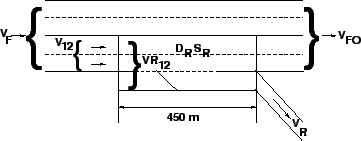
V12 is the flow rate entering ramp influence area (pc/h), and
vR is the Off-ramp demand flow rate (pc/h). at the diverge area.
V12 is the flow rate entering ramp influence area (pc/h), and
vR is the Off-ramp demand flow rate (pc/h).
Figure 1:
Typical diverging area diagram
 |
The general model given by HCM 2000 treats as the sum
of the off-ramp flow plus a proportion of the through freeway flow.
 |
(1) |
where,
is the flow rate in lanes 1 and 2 of freeway upstream of diverge area
in (pc/hr),
 is the freeway demand flow rate immediately upstream of diverge in
(pc/h), and is the freeway demand flow rate immediately upstream of diverge in
(pc/h), and
 is the proportion of through freeway flow remaining in lanes 1 and 2
immediately upstream of diverge.
For four lanes freeway (2 lanes in each direction) is 1.00.
As in the merge area analysis, determining the capacity is the second step of
the diverge area analysis.
Three limiting values should be checked: is the proportion of through freeway flow remaining in lanes 1 and 2
immediately upstream of diverge.
For four lanes freeway (2 lanes in each direction) is 1.00.
As in the merge area analysis, determining the capacity is the second step of
the diverge area analysis.
Three limiting values should be checked:
- Total flow that can depart from the diverge: this is limited by the
capacity of the lanes in the freeway prior to approach of the diverge.
- The capacities of the departing freeway leg or legs or ramp or both.
This is the most important of the three as generally diverge areas fail due to
failure of one or more exit legs..
- (approaching flow) prior to deceleration lane: this flow also
includes the off-ramp flow and must be checked against capacity.
Determine the level of service (LOS) of the diverge area is the third step of
the diverge area analysis.
LOS criteria for diverge area are based on density in the diverge influence
area.
HCM 2000 provides the equation to estimate the density in the merge influence area.
 |
(2) |
where,
 is the density of diverge influence area (pc/km/ln),
is the flow rate entering ramp influence area (pc/h), is the density of diverge influence area (pc/km/ln),
is the flow rate entering ramp influence area (pc/h),
 is the length of deceleration lane(m), and
a, b & c are constants.
This equation is applicable only for under saturated conditions of flow.
The density calculation is not done when either of the three capacities mentioned earlier are exceeded.
In such cases, the LOS is assigned as F. is the length of deceleration lane(m), and
a, b & c are constants.
This equation is applicable only for under saturated conditions of flow.
The density calculation is not done when either of the three capacities mentioned earlier are exceeded.
In such cases, the LOS is assigned as F.
|
|
| | |
|
|
|


