| |
| | |
|
Metering strategies can be defined as the approach used to control the traffic
the flow on the ramps.
Three Ramp metering strategies are available to control the flow on the ramps
which can enter the busy freeway.
Capacity of an uncontrolled single-lane freeway entrance ramp is 1800 to 2200
vehicles per hour (VPH).
Since Ramp metering is a traffic flow controlling approach it decreases the
capacity of the ramps.
Three ramp-metering strategies are as follows:
Single-lane one car per green ramp metering strategy allows only one car to
enter the freeway during each signal cycle.
The salient features of this strategy are:
- The length of green plus yellow indications is set to ensure sufficient
time for one vehicle to cross the stop line.
The length of red interval should be sufficient to ensure that the following
vehicle completely stops before proceeding.
- A typical cycle length is taken as, the smallest possible cycle is 4
seconds with 1 second green, 1 second yellow, and 2 seconds red.
This produces a meter capacity of 900 VPH.
- A more reasonable cycle is around 4.5 seconds, obtained by increasing the
red time to 2.5 seconds.
This increase in red would result in a lower meter capacity of 800 VPH.
Single-Lane Multiple Cars per Green is also known as Platoon metering, or bulk
metering.
This approach allows two or more vehicles to enter the freeway during each
green indication.
The most common form of this strategy is to allow two cars per green.
The salient features of this type of ramp metering are:
- Three or more cars can be allowed; however, this will sacrifice the
third objective(breaking up large platoons).
- Furthermore, contrary to what one might think, bulk metering does not
produce a drastic increase in capacity over a single-lane one car per green
operation.
This is because this strategy requires longer green and yellow times as ramp
speed increases, resulting in a longer cycle length.
Consequently, there are fewer cycles in one hour.
- Two cars per green strategy requires cycle lengths between 6 and 6.5
seconds and results in metering capacity of 1100 to 1200 VPH.
This analysis illustrates that bulk metering does not double capacity and this
finding should be noted.
In dual lane metering two lanes are required to be provided on the ramp in the
vicinity of the meter which necks down to one lane at the merge.
The salient features of this type of ramp metering are:
- In this strategy, the controller displays the green-yellow-red cycle for
each lane.
- Synchronized cycles are used such that the green indications never occur
simultaneously in both lanes.
- The green indications are timed to allow a constant headway between
vehicles from both lanes.
Dual-lane metering can provide metering capacity of 1600 to 1700 VPH.
- In addition, dual-lane ramps provide more storage space for queued
vehicles.
The quality of ramp metering essentially implies the efficiency of handling the
flow and reducing unnecessary delays through metering strategies.
For a ramp meter to produce the desired benefits, the engineer should select a
metering strategy appropriate for the current or projected ramp demand.
The ramp width will depend on this selection.
The following fig. 1 shows the metering availability
(percent of time the signal is metering) of the three metering strategies for a
range of ramp demand volumes.
Figure 1:
Comparison of metering quality of different approaches with Ramp
demand volume
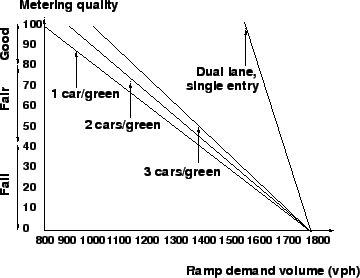 |
In Figure 1, if the flow on a single lane ramp which has
Single-Lane One Car per Green approach is 1000 vph, then the metering
availability is only 80 percent since the metering approach installed has the
capacity of 800 vph.
Therefore metering availability decreases as the traffic flow increases.
If the flow is around 1600 vph then Dual-Lane Metering gives 100 percent
metering availability.
Thus it is imperative to select the metering strategy based on the flow and
accordingly select the required ramp width.
|
|
| | |
|
|
|


