|
The car following model proposed by General motors is based on follow-the
leader concept.
This is based on two assumptions; (a) higher the speed of the vehicle, higher
will be the spacing between the vehicles and (b) to avoid collision, driver
must maintain a safe distance with the vehicle ahead.
Let
 is the gap available for is the gap available for
 vehicle, and
let vehicle, and
let
 is the safe distance, is the safe distance,  and and  are the
velocities, the gap required is given by, are the
velocities, the gap required is given by,
 |
(1) |
where  is a sensitivity coefficient.
The above equation can be written as is a sensitivity coefficient.
The above equation can be written as
 |
(2) |
Differentiating the above equation with respect to time, we get
General Motors has proposed various forms of sensitivity coefficient term
resulting in five generations of models.
The most general model has the form,
![$\displaystyle a^t_{n+1} =
\left[\frac{\alpha_{l,m}{(v^t_{n+1}})^m}{{(x^t_n-x^t_{n+1}})^{l}}\right]\left[v_n^{t}-v^t_{n+1}\right]$](img11.png) |
(3) |
where  is a distance headway exponent and can take values from +4 to -1, is a distance headway exponent and can take values from +4 to -1,  is a speed exponent and can take values from -2 to +2, and
  is a
sensitivity coefficient.
These parameters are to be calibrated using field data.
This equation is the core of traffic simulation models. is a
sensitivity coefficient.
These parameters are to be calibrated using field data.
This equation is the core of traffic simulation models.
|


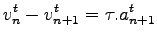
![$\displaystyle a^t_{n+1} = \frac{1}{\tau}[v^t_{n}-v^t_{n+1}]$](img10.png)