The concept of this model is that each driver tries to achieve an optimal
velocity based on the distance to the preceding vehicle and the speed
difference between the vehicles.
This was an alternative possibility explored recently in car-following models.
The formulation is based on the assumption that the desired speed
depends on the distance headway of the th vehicle.
i.e.
where is the optimal velocity function which is a function of the
instantaneous distance headway
.
Therefore is given by
(1)
where
is called as sensitivity coefficient. In short, the
driving strategy of vehicle is that, it tries to maintain a safe speed
which in turn depends on the relative position, rather than relative speed.


 depends on the distance headway of the
  th vehicle.
i.e.
th vehicle.
i.e.
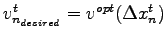 where
where  is the optimal velocity function which is a function of the
instantaneous distance headway
is the optimal velocity function which is a function of the
instantaneous distance headway
 .
Therefore
.
Therefore  is given by
![$\displaystyle {a_n^t} =[1/\tau][V^{opt}{({\Delta}x_n^t)}-{v_n^t}]$](img7.png)
 is called as sensitivity coefficient. In short, the
driving strategy of
is called as sensitivity coefficient. In short, the
driving strategy of  vehicle is that, it tries to maintain a safe speed
which in turn depends on the relative position, rather than relative speed.
vehicle is that, it tries to maintain a safe speed
which in turn depends on the relative position, rather than relative speed.