3.3.1.5 Reactions with Epoxides
The epoxide is attacked by organocopper reagents at the least substituted carbon atom giving the corresponding alcohol (Scheme 10).
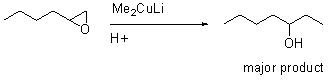 |
Scheme 10 |
3.3.2 Higher Order Mixed Cuprates
Cuprates are useful but there are a few problems associated with them. To overcome these limitations, Lipshutz developed higher order mixed cuprates, R2Cu(CN)Li2, by the reaction of organolithium reagent with cuprous cyanide (Scheme 11).
 |
Scheme 11 |
Higher order cuprates show greater reactivity compared Gilman reagents with alkyl halides, even secondary halides. For example, (S)-2-bromooctane reacts with EtMeCu(CN)Li at 0°C to give (R)-3-methylnonane in 72% yield (Scheme 12).
 |
Scheme 12 |
Opening of epoxides ring is more efficient with the higher order cuprate than with Gilman reagents, and attack takes place at the less sterically hindered carbon (Scheme 13).
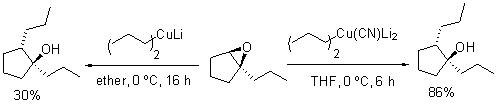 |
Scheme 13 |