Organocopper reagents are prepared by transmetallating the organomagnesium, organolithium or organozinc reagent with copper(I) salts (Scheme 1). There are two major reactions with organocuprates: (1) reaction with alkyl halides and (2) conjugate addition with α,β-unsaturated carbonyl compounds. The substitution reactions are promoted by the use of THF or ether-HMPA solvent, while the conjugate addition is facile when ether is employed as a solvent. The general reactivity of organocuprates with electrophiles follows the order:
RCOCI > R-CHO > R-OTs > R-I > R-Br > R-CI > RCOR > R-CO2R' R-CN > RCH = CH2 |
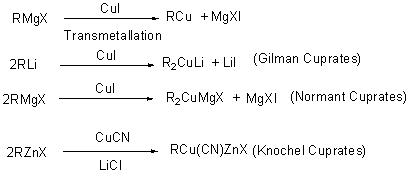 |
Scheme 1 |
3.3.1 Reactions with Dialkylcuprates (Gilman Reagent)
3.3.1.1 Coupling Reactions
Organocuprates can replace halide ion from primary and secondary alkyl halides to give cross-coupled products (Scheme 2). This method provides effective route for the construction C-C bond between two different alkyl halides, which is not possible by the well known Wurtz coupling reaction, in which a number of products are formed.
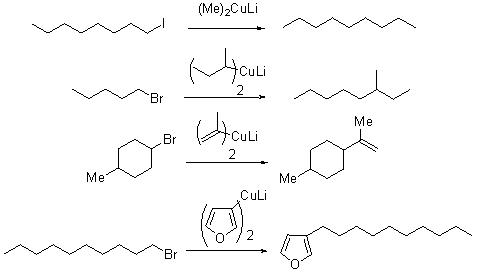 |
Scheme 2 |