3.3.1.2 Reactions with Acid Chlorides
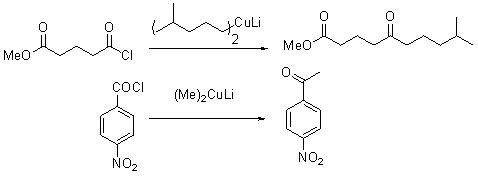
The reaction of a dialkyl cuprate and acid chloride is a preferred method to synthesize ketones (Scheme 5). Unlike in the case of Grignard reagents, the ketones formed do not react with organocopper reagent.
 |
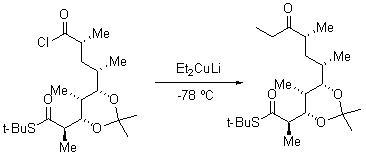 |
Scheme 5 |
3.3.1.3 Conjugate Addition
Conjugate addition is among the basic carbon-carbon bond forming reactions. Traditionally, organocopper reagents were choice to undergo this synthetic transformation. The organocopper reagents are softer than Grignard reagents (because copper is less electropositive than magnesium), and add in conjugate fashion to the softer C=C double bond.
The mechanism of the transfer of the alkyl group from the organocuprates to the β-position of the carbonyl compounds is uncertain. It is believed that initially a d-π* complex between the organocopper(I) species and the enone is formed followed by the formation of a Cu(III) intermediate which may undergo reductive elimination to form the product (Scheme 6).
 |
Scheme 6 |
In the case of enones, consecutive addition of the organocopper reagent and alkyl halides, two different alkyl groups can be introduced in one operation (Scheme 7).
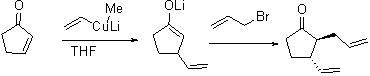 |
Scheme 7 |