The reaction between organozinc compound and an organic halide in the presence of Pd(0) or Ni(0) species is known as Negishi cross-coupling reaction which is one of the most widely used cross-coupling reactions. The mechanism of this reaction involves oxidative addition followed by transmetallation with the zinc compound and subsequent reductive elimination (Scheme 13). This reaction can be applied to highly substituted substrates. An interesting example of application of Negishi coupling is the synthesis of hexaferrocenyl benzene (Scheme 14).
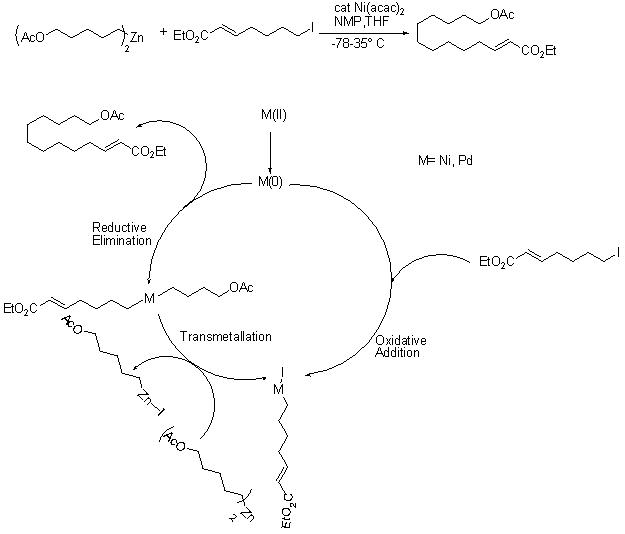 |
Scheme 13 |
 |
Scheme 14 |
Besides Negishi cross-coupling, Ni and Pd salts are also known to catalyze the cyclization reactions of organozincs via a radical pathway. In these cases, an intermediate Ni(0) or Pd(0) is formed which initiates a radical chain providing a new zinc derivative which can further undergo reaction with other electrophiles (Scheme 15).
 |
Scheme 15 |