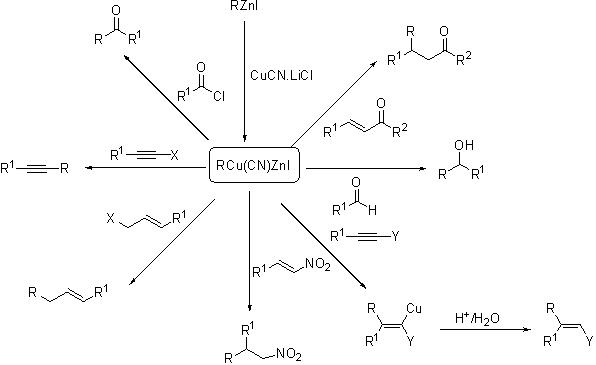
Organozinc reagents readily undergo transmetallation thereby making them suitable candidates to be used in conjunction with transition metal salts. Thus, RZnI reacts with THF soluble salt CuCN·LiCl to form new copper-zinc reagents which are usually formulated as RCu(CN)ZnI. The reactivity of this reagent is shown in Scheme 7.
 |
Scheme 7 |
3.2.2 Cyclopropanation by Organozinc Reagents
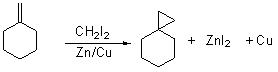
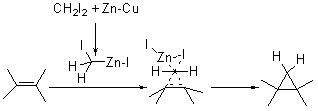
Alkenes may be conveniently converted to cyclopropanes by treatment with methylene iodide and Zn/Cu couple. This reaction is known as Simmons-Smith cyclopropantion. The reactive species is iodomethylzinc iodide (Scheme 8).
 |
 |
Scheme 8 |
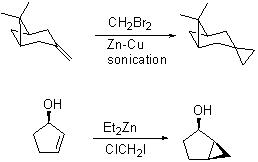
Several modifications are available to allow the use of less reactive methylene group donors like chloroiodomethane. Such methods employ the use of Lewis acids like TiCl4 or organic reagents like acetyl chloride or trimethylsilyl chloride (Scheme 9). This reaction is also sensitive to the purity of zinc. Thus electrochemically prepared zinc is more effective than metallurigally prepared zinc.
 |
Scheme 9 |