Organozinc reagents were the first organometallic compounds prepared in the laboratory. They are non-polar and soluble in organic solvents. Organozinc reagents are less reactive than the Grignard reagents. For example, organozinc reagents don’t react with carbon dioxide and react slowly with ketones, esters and cyanides. However, organozinc reagents smoothly undergo transmetallation with a variety of transition metal salts or complexes leading to new transition metal complexes, thus allowing new reaction pathways not available to the main group metal zinc (Scheme 1).
 |
Scheme 1 |
3.2.1 Preparation
Reaction of alkyl iodides with zinc dust gives organozinc halides. This method allows the preparation of organozinc iodides bearing almost all organic functionalities (Scheme 2). The zinc dust is treated with a few mol% of 1,2-dibromoethane and TMSCl prior to the halide addition.
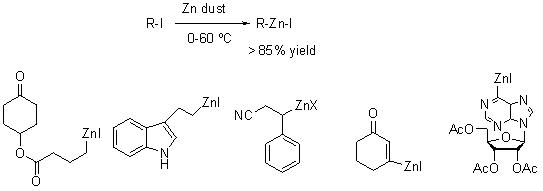 |
Scheme 2 |
Alternatively, more activated zinc can be prepared by the reduction of ZnCl2 that react even less reactive aryl iodides or bromides (Scheme 3). Using this procedure many heteroarylzinc reagents can be prepared.
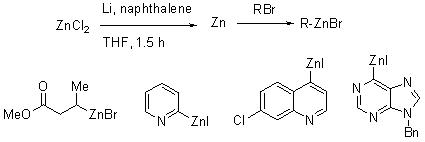 |
Scheme 3 |