3.2.1 Nucleophillic Addition by Organozinc Reagents
Reformatsky reaction is one of the most important applications of organozinc reagent formed in situ. In this reaction zinc, α-haloester and a carbonyl compound react to give β-hydroxyester. The reaction involves the formation of a zinc enolate which attacks the carbonyl group (Scheme 4). As the zinc enolate is only weakly basic so the reaction works even in the presence of highly enolisable carbonyl partner. Sterically hindered ketones do not pose a problem for this reaction.
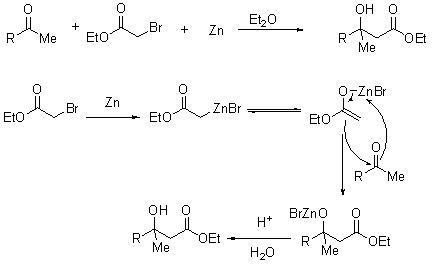 |
Scheme 4 |
In case of α,β-unsaturated carbonyl compound the addition takes place regioselectively in a 1,2 fashion (Scheme 5).
 |
Scheme 5 |
The combination of Zn/CH2Br2/TiCl4 is known as Lombordo reagent which can convert ketones to methylene group. The reaction is believed to proceed through a dimetalated intermediate which adds to the ketone (Scheme 6).
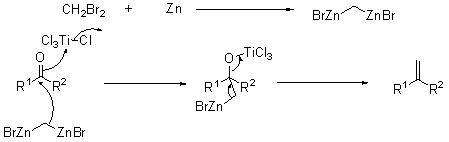 |
Scheme 6 |
N. A. Petasis, J. P. Staszewshi, Encyclopedia of Reagents for Organic Synthesis, John Wiely and Sons, Inc., L. A. Paquette, Ed., New York, 1995, 3, 1565. |