Simmons Smith reaction is highly stereospecific reaction as it does not involve a carbene intermediate (:CH2). In case additional directing groups, the reaction exhibits considerable stereoselectivity. In Scheme 10, the stereoselectivity of the reaction is explained by the coordination of zinc to allylic oxygen in the transition state.
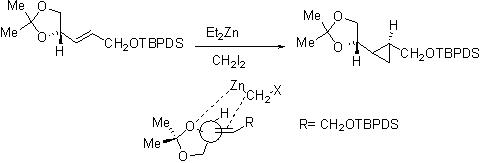 |
Scheme 10 |
Other reagents have been developed having aryloxy or acetoxy anions. These reagents are effective for cyclopropanation of unactivated alkenes. They are prepared by the reaction of diethyl zinc with a suitable oxyanion precursor such as trifluoroacetic acid followed by reaction with methylene iodide to generate reagents having formula ROZnCH2I. The reactivity of the oxyanions are in the order CF3COO- > ArO- > RO-.
3.3.3 Transition Metal Mediated Addition of Organozinc Reagents
As mentioned earlier, organozinc reagents can be used in conjunction with various transition metal salts which may be added in either stoichiometric amount or catalytic amount. This transmetallation reaction has been already discussed in the previous section for copper salts. In this section we will see the effect of Pd, Ni, Fe and Co salts on the addition of organozinc reagents.
One of the most useful reactions using Co is the carbonylation reaction. Organozinc reagents when treated CoBr2 genarate organocobalt reagents which are stable for several hours at low temperature. Carbonylation is now possible by simply bubbling CO through such a solution (Scheme 11).
 |
Scheme 11 |
Addition of cobalt salts in catalytic amount is known for acylation and allylation reaction of diorganozincs. The reaction occurs in a SN2 fashion but, not by SN2’ fashion, thereby leading to a complete retention of double bond geometry (Scheme 12).
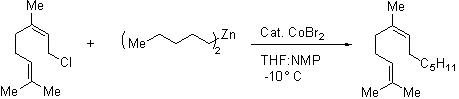 |
Scheme 12 |