2.3.4 Reduction of Aromatic Compounds
Reduction of aromatic compounds could be performed with molecular hydrogen in the presence of metal catalysts such as Pt, Pd, Rh, Ru and Raney nickel (Scheme 5). The choice of metal catalyst depends on the nature of substrates. For example, the aromatic ring could be selectively reduced in the presence of an ester or acid group using molecular hydrogen with nickel or platinum catalyst.
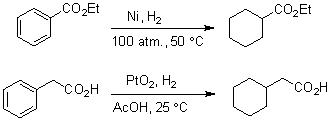 |
Scheme 5 |
2.3.5 Reduction of Aromatic Nitro Compounds
The aromatic nitro compounds can be reduced to give the corresponding amines when treated with molecular hydrogen in the presence of Pt, Pd or Ni catalyst (Scheme 6). The reaction is generally performed in methanol, ethanol or ethyl acetate at ambient temperature.
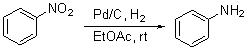 |
Scheme 6 |
2.3.6 Reduction of Acid Chlorides
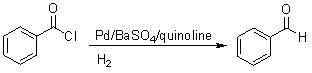
Acids chlorides undergo reduction to give the corresponding aldehydes in the presence of molecular hydrogen and palladium catalyst (Scheme 7). When Pd/BaSO4/quinoline is used as a catalyst along with molecular hydrogen the reaction is called Rosenmund reaction.
S. Siegel, Encyclopedia of Reagents for Organic Synthesis, John Wiley and Sons, Inc., L. A. Paquette, Ed., New York, 1995, 6, 3861. |
 |
Proposed Mechanism
 |
Scheme 7 |