2.3.1 Introduction
Hydrogen is the most abundant chemical element in the universe with atomic number 1 and symbol H. It has three isotopes hydrogen 1H, deuterium 2D and tritium 3T and the 1H is the most abundant (99.98%). The hydrogen 1H and deuterium 2D are stable isotopes whereas the tritium 3T is a radioactive. In organic chemistry, hydrogen is used to reduce a variety of functional groups but the hydrogen gas itself can not reduce any functional groups without a catalyst.
2.3.2 Reduction of Carbon-Carbon Double Bonds
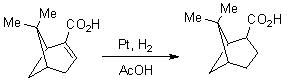
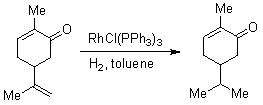
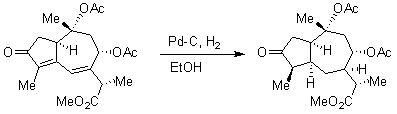
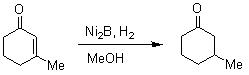
The reduction of carbon-carbon double bond is academically as well as industrially important transformation (Scheme 1). The order of hydrogenation of substituted double bond is 1,1-di > 1,2-di > 1,2-tri > 1,2-tetra substituted. Different metal catalysts have been used for the purpose. Among them, platinum (Pt), iridium (Ir), ruthenium (Ru), rhodium (Rh), palladium (Pd) and nickel (Ni) catalysts are commonly used.
Ni Catalysts: C. R. Sarko, M. DiMare, Encyclopedia of Reagents for Organic Synthesis, John Wiley and Sons, Inc., L. A. Paquette, Ed., New York, 1995, 6, 3701; Pd Catalysts: A. O. King, I. Shinka, Encyclopedia of Reagents for Organic Synthesis, John Wiley and Sons, Inc., L. A. Paquette, Ed., New York, 1995, 6, 3867; E. M. Leahy, Encyclopedia of Reagents for Organic Synthesis, John Wiley and Sons, Inc., L. A. Paquette, Ed., New York, 1995, 6, 3887; Pt Catalysts: A. O. King, I. Shinka, Encyclopedia of Reagents for Organic Synthesis, John Wiley and Sons, Inc., L. A. Paquette, Ed., New York, 1995, 6, 4159; 4160; Rh Catalysts: S. Siegel, Encyclopedia of Reagents for Organic Synthesis, John Wiley and Sons, Inc., L. A. Paquette, Ed., New York, 1995, 6, 4405; Ru Catalysts: S. Siegel, Encyclopedia of Reagents for Organic Synthesis, John Wiley and Sons, Inc., L. A. Paquette, Ed., New York, 1995, 6, 4410. |
Platinum oxide (PtO2) also known as Adam’s catalyst is generally used for the platinum catalyzed hydrogenation reaction. Other catalysts such as Pd on charcoal, Wilkinson’s catalyst RhCl(PPh3)3, Crabtree’s catalyst [Ir(cod)(PChx3)(py)]PF6, Ru(OAc)2(BINAP), Raney nickel and Nickel boride (Ni2B) are used. These reactions are performed in ethyl acetate, alcohols and acetic acid as solvents.
 |
 |
 |
 |
Scheme 1 |
For mechanism of hydrogenation, see: lecture 33, Principles of Organic Synthesis |