McMurry reaction is also used to synthesize alkenes from dicarbonyl compounds using Ti(0) generated in situ . The reduction may be carried out by a variety of reagents like Zn-Cu couple, LiAlH4 and alkali metals Li, Na and K (Scheme 6). This reaction first produces 1,2-diol which is then dehydrated on the surface of titanium into an alkene. The reaction is not stereospecific since the two the carbon-oxygen bonds do not break simultaneously.
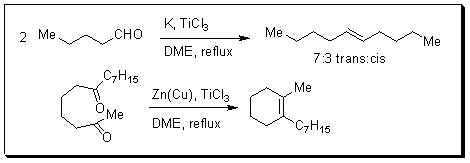
Scheme 6
This methodology can be extended to ketoesters, where a cyclic enol ether is produced which on hydrolysis gives cycloalkanone (Scheme 7).
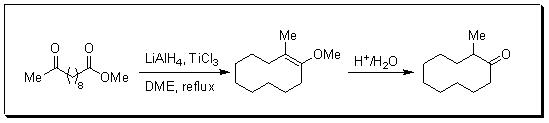
Scheme 7
3.6.1.3 Polymerization
Perhaps the most famous titanium catalyst is a mixture of TiCl4 and AlMe3 which is known as Zieglar-Natta catalyst. Today, a great variety of catalysts having a Ti, Zr or Hf centre along with Mg or Al co-catalyst are known by this generic name. The polymerization of alkenes carried out by these catalysts can be highly stereoregular by suitable tailoring of the catalyst. This has been widely used for the polymerization of high density polyethylene, polypropylene and polybutadiene among other alkenes. Zieglar-Natta catalysts can be classified into 3 classes.
- • Titanium chloride based catalysts. The catalysts are usually supported on silica supports and can be used for homopolymerization as well as polymerization of isotactic 1-alkenes.
• Metallocene based catalysts. Early transition metal metallocenes along with methylalkoxyaluminium compounds as co-catalyst have been used for the polymerization of alkenes. The metallocene complexes are usually bent sandwich complexes with formula Cp2 MCl2 (M= Ti, Zr, Hf).
• Coordination complexes as catalysts. A variety of coordination complexes of different metals in conjunction with alkoxyaluminium as co-catalysts are known to polymerize alkenes.