3.6.1 Introduction
Transition metals can be defined as an element whose atoms have an incomplete d -shell or which can give rise to cations with an incomplete shell. Due to incompletely filled d -orbitals it can exhibit a large number of oxidation states. The lower oxidation states can act as reducing agent while the higher oxidation states act as oxidizing agents. Some transition metals exhibit a pair of oxidation states in which the process of redox reaction is very facile. Pd(0)/Pd(II), Cu(I)/Cu(II) and Ni(II)/Ni(IV) are examples of such oxidation states. As such, these oxidation states may support catalytic cycles.
Transition metals can also bind to an organic ligand thus forming a metal-carbon bond. The metal-carbon bond may have σ-character or π-character or both. In case of a bond formation between a d -orbital of the metal with a s -containing hybrid orbital of carbon it gives rise to a σ-organometallic compound. Similarly, if the bond is formed between a d-orbital of a metal with π-orbitals of ligand then it gives rise to π-organometallic compound. In the latter case, bonding is provided by both donation from a filled π-orbital of the ligand to the empty orbital of metal and by the interaction of an unfilled π*-orbital of the ligand with the filled metal d -orbital. Gilman's reagent is an example of the former type of organometallic compounds while Zeise complex is an example of the latter variety.
3.6.1 Titanium Catalysts
Titanium is a 3d series transition element belonging to Group IV. Thus, it has a low valence shell electron density compared to other transition metals belonging to other group. Since the valence shell electrons are strongly attracted by the nucleus, titanium has a high ionization potential. However, once ionized, Ti can attain up to +IV oxidation state. The cationic species are strong Lewis acids and, therefore, they have found application in a wide variety of Lewis acid catalyzed reactions.
3.6.1.1 Lewis Acid Catalysis
The Lewis acidity of TiCl4 is applied in case of aldol reaction, Micheal addition, Claisen condensation and reductive hydrolysis among many other reactions. Some examples of these are exemplified in Scheme 1.
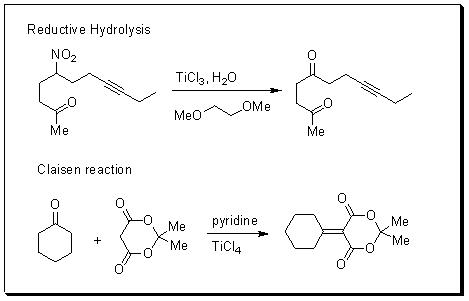
Scheme 1