6. Pollution and Contamination
6.1 Preface: The term contaminant is often used synonymously with pollutant, although difference in the definitions would indicate that these terms are not interchangeable. Contaminant implies concentration of a substance is higher than would naturally occur but does not necessarily mean that the substance is causing any harm. However, pollution refers to a situation in which the concentration of a substance is higher than would naturally occur but also indicate that the substance is causing harm of some type. Therefore, a soil could be contaminated but not polluted. Pollution is often broadly categorized according to its source:
Point-source pollution: As the name implies, is pollution with a clearly identifiable point of discharge. E.g. waste water treatment plant etc
Nonpoint-source pollution: Is pollution without an obvious single point of discharge. E.g. Surface runoff of a commonly used lawn herbicide.
6.2 Classification of Potential Pollutants
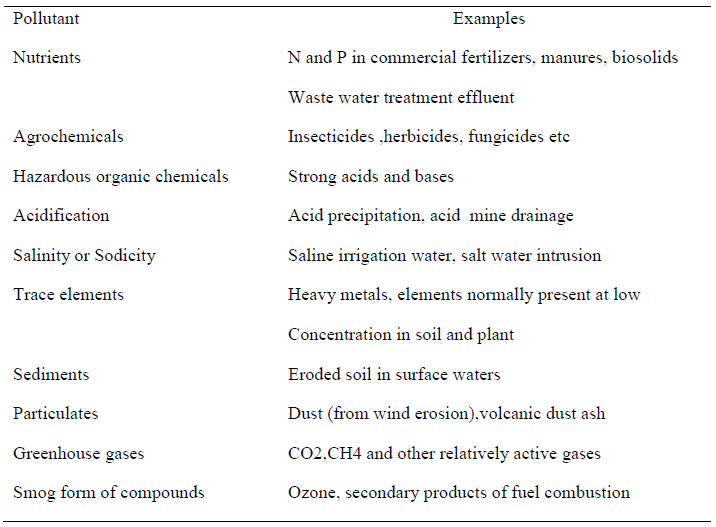
6.3 Mechanism of Pollution Transport through soil
6.3.1 Contaminant Fate and Transport
FATE: The environment plays a key role in the ultimate fate and transport of contaminants. The specific fate of contaminant following their release into the environment, depends on their chemical structure which is highly variable, abiotic factors within the receiving environment (e.g. organic carbon, ph, surface water) and interaction with the biotic environment which can result in degradation, transformation or bioconcentration of the contaminants. Once contaminants also reach the soil, they move in one of these directions:
- Vapourized into the atmosphere without chemical change
- Absorbed by soils, move downward through the soil in liquid or solution form and
can be lost from the soil by leaching. - Undergo chemical reactions within or on the surface of the soil
- Broken down by soil micro-organisms
- Washed into streams and rivers in surface run-off
- Taken up by plants or soil animal and move up the food chain