4. The Concept of Environmentalism
Environmental quality seems to be a new topic when in fact; the current emphasis on
environmental quality is a renewed interest in an old topic. We are becomingincreasingly aware that exposure to various substances may cause human health
problems ranging from death to subclinical effects such as attention deficit syndrome.
The natural tendency is to eliminate or reduce our exposure to substances that we
suspect may adversely affect human health.
An environmentalist is a person who works towards solving environmental problems and environmentalism is an attitude by a group of individuals, perhaps the whole society that the environment takes a high priority in the decision-making process. A more philosophical approach categorizes an individual’s attitude about the environment into one of the three groups, namely:
- Egocentric- In which an individual in an individual’s action are guided solely
by concern for him or herself
- Homocentric- meaning concern for the human species
- Ecocentric- meaning an overall concern for the environment.
Society as a whole and most individual have progressed slowly from egocentric
attitudes towards more ecocentric attitudes.
5. SOIL QUALITY AND FUNCTIONS OF SOIL
Introduction
As compared to the environment of compartments air and water, soil is an extremely complex system. This is due to a huge variety of soil properties and chemical, physical and biological system conditions. The combination of these makes the development of general rules for quantitative evaluation of soil quality impossible. This is because soils have a much higher buffering capacity than air and water. This property (buffering capacity) is the capacity to allow contents of compounds, once present at optimum level, to increase without actual occurrence at negative effects.
5.1 Soil Quality in Relation to Soil Functions
The quality of soil is adversely influenced by contamination (pollution) of the system. The concepts of “contamination” and “pollution” of soil are used in a comparable way as they reflect only a difference in degree of drainage to the soil system. Any addition to soil, i.e contaminants- meaning the compounds that may exert adverse effect on soil functioning. It can be defined as soil contamination. Because most soils do have a certain buffering capacity, it usually takes some time before the negative effects become apparent. Once this situation occur, the soil can be considered as polluted, which for all practical purposes means that malfunctioning or dysfunctioning of the soil is apparent due to abundant pressure or availability of the compounds. Such malfunctioning may refer to one specific function in a particular but sometimes also in combination of different functions are:
- The bearing function: For instance as playground for children and for building of
houses/structures.
- The Plant growth function: This may refer to natural vegetation and the production of
crops for animal and human consumption
- The filtering function of water: Ground water as well as surface water
- The ecological function of soil: With its contribution to element cycling as an important aspect
Proper functioning of soil as stated above imposes a wide variety of quality criterion. This strongly hampers the introduction of a quality assessment methodology with general applicability and validity. At first sight, the bearing function would probably be the least demanding, at least once certain physical requirements are met. However, experience has shown that for building of houses, some minimal requirements of chemical conditions in the soil are needed; and a combination of use of the same site for waste disposal and later for urban expansion is not always without problems.
Methods to assess health risks for people living in an area where there is unconscious combination of soil usages or in polluted areas, requires insight in the quantitative relationships between pollutant exposure of the organism under consideration on one side and the resulting effects to be expected from the exposure on the other side.
In the case of human, the exposure pathways are:
- Soil ingestion, especially for children
- Inhalation of air ,containing volatile polluting compounds
- Drinking water
- Food in the form of plant products and animal products
- Radiation exposure
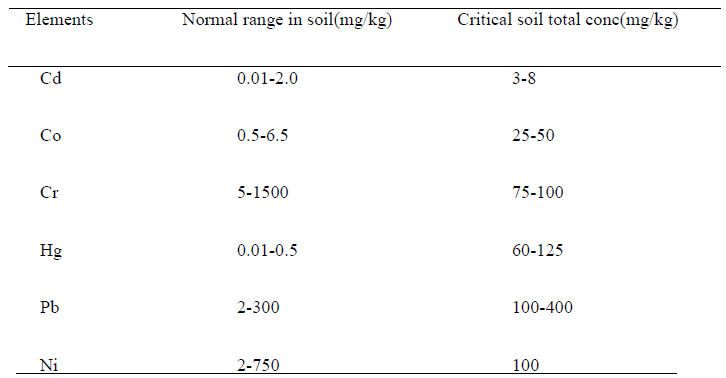
As a result of the adverse effects of heavy metals and other contaminants, environmental agencies proposed critical levels in soil above which toxicity is considered to be possible. For example the Table below shows the normal range and critical total concentrations of heavy metals for soil (Kabata-Pendias and Pendias, 1984).