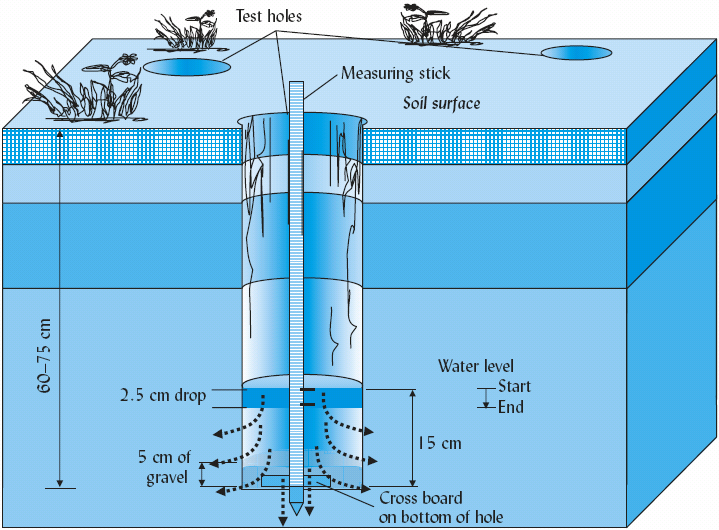
 The perc test used in some places to help determine soil suitability for a septic tank drain field. On the site proposed for the drain field, a number of holes are augered, or excavated, to the depth where the perforated pipes are to be laid. The bottom of each hole is lined with gravel, and the holes are filled with water as a pretreatment to ensure that the soil is wet when the test is conducted. After the water has drained, the hole is refilled with water and a measuring rod is used to determine how long it takes for the water level to drops by 2.5 cm. This measurement is related to the saturated hydraulic conductivity. [Based on New York State Department of Health (2004); diagram courtesy of R. Weil]
4.3 Soil drainage:
Why do we drain the soil? Let's list the pros and the Cons:
4.3. Drainage Systems:
Surface drainage Systems: ditches used to channelize overland flow or re- distribution of soil to promote flow over a desired area.
Sub surface Drainage Systems: the object is to create larger flow paths for the water than the pore spaces in the soil. There is less resistance to flow in the pipe so the excess water will flow through the pipe and be removed from the soil.
Trench Drainage is also used to drain water from soils. The water is pulled from the soil into the trench because there is less resistance to flow in the ditch.
Fresh water is precious, but too much of it can be a problem.
Main Objectives
1.
Understand the fundamentals about water resources
2. Comprehend the main factors that determine and influence irrigation
3.
Capable of describing the dilemma of wetland conservation/utilization
Key Terms and Concepts
Evaporation
Transpiration
Infiltration
Percolation
Oxidative sulfur transformation
Reductive sulfur transformation