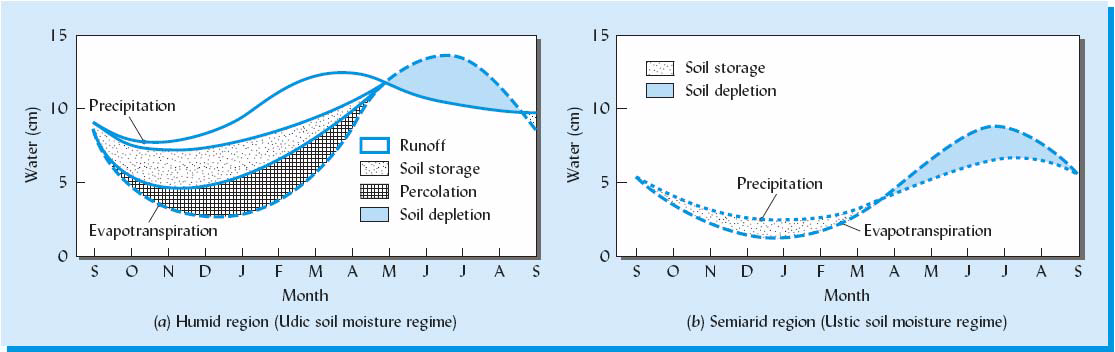
 Seasonal water balance curves for two temperate zone regions: (a) a humid region and (b) a semiarid region. Note that actual ET shown is restrained by the water supply available. Potential evapotranspiration (PET), not shown, would be much higher, especially in (b). Percolation through the soil is absent in the semiarid region. In each case, water is stored in the soil and later released when ET exceeds precipitation.
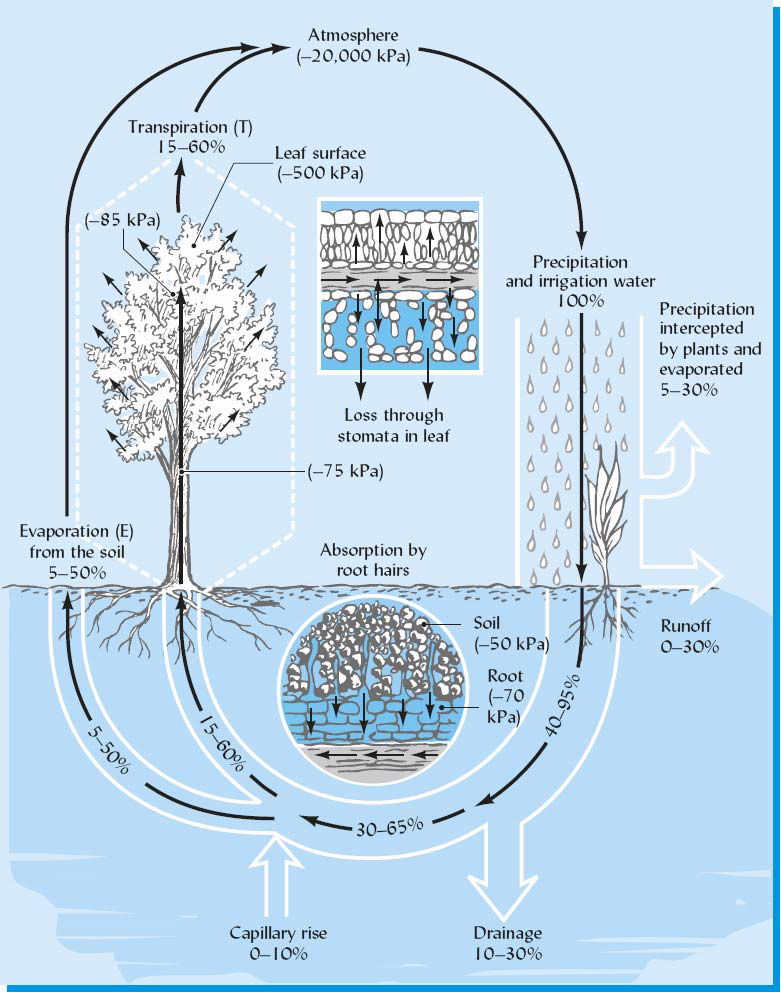 |
Soil–plant–atmosphere continuum (SPAC), showing water movement from soil to plants to the atmosphere and back to the soil in a humid to subhumid region. Water behavior through the continuum is subject to the same energy relations covering soil water that were discussed in Chapter 5. Note that the moisture potential in the soil is – 50 kPa, dropping to –70 kPa in the root, declining still further as it moves upward in the stem and into the leaf, and is very low (–500 kPa) at the leaf–atmosphere interface, from whence it moves into the atmosphere, where the moisture potential is –20,000 kPa. Moisture moves from a higher to a lower moisture potential. Note the suggested ranges for partitioning of the precipitation and irrigation water as it moves through the continuum. Over 98% of the water absorbed by the roots of plants is transpired as water vapor over the course of the growing season. |
Irrigation Principles and Practices:
Irrigating crops in sunny/warm regions can produce higher crop yields than regions that get all water from rainfall. Irrigated crops are responsible for 40% of global crop production and uses 80% of water consumed.
In arid regions only 50 – 30% of water allocated for irrigation reaches the plant roots.
Percent Field Water Efficiency: water transpired by the crop divided by Water applied and multiply by 100. Increasing this efficiency depends on techniques of irrigation, but it is not possible to get over 85 – 90%.
Salinity Buildup: Fresh water applied to a soil can either dissolve the salts and carry them through the soil column, then be deposited downstream causing toxic levels of salt in streams or rivers; or bring salts to the soil surface by evaporation if the salts are not washed away.