4. Wetlands and Drainage
4.1. Wetland functions:
You should know the reasons behind each item on the list of beneficial functions of wetlands in the textbook.
Flooding and anaerobic processes:
Redox potentails:
4.2 Sulfur reduction/oxidation
(1) Desulfuration (analogous to ammonification):
R-S-H (e.g., DMS, CH3SCH3) + H2O ----R-H + H2S
(2) Oxidative transformations:
H2S (or DMS) + O2 → S0 + O2 → H2SO4
Sulfur oxidation produce acids, so Thiobacillus thiooxidans and Thiobacillus ferrooxidans are used in mining.
Fossil fuel sulfur: |
SO2 + H2O → H2SO3(sulfurous acid) |
or |
SO3 + H2O → H2SO4 (sulfuric acid) |
(3) Reductive sulfur transformations:
SO4= → SO3= → S0 → H2S
Sulfate reduction occurs at wide range of pH values, pressure, temperature and salinity. Sulfate reduction is inhibited by oxygen, nitrate, ferric ions. H2S is very toxic to aerobes and plant roots. Assimilatory sulfate reduction happens in many organisms.
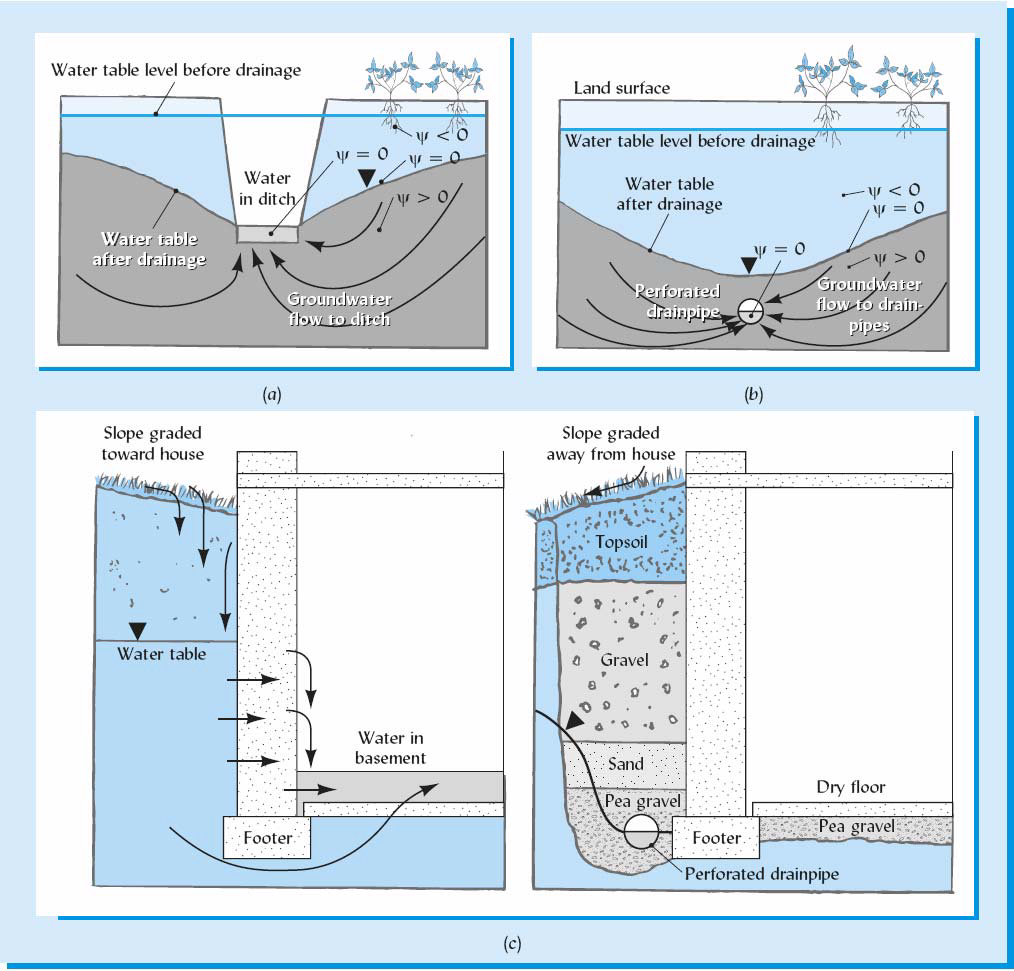 |
Three types of subsurface drainage systems. (a) Open ditches are used to lower the water table in a poorly drained soil. The wet season levels of the water table before and after ditch installation are shown. The water table is deepest next to the ditch, and the drainage effect diminishes with distance from the ditch. (b) Buried “tile lines” made of perforated plastic pipe act very much as the ditches in (a), but have two advantages: they are not visible after installation and they do not present any obstacle for surface equipment. Note the flow lines indicating the paths taken by water moving to the drainage ditches or pipes in response to the pressure potential gradients between the submerged water and free water in the drainage ditch and pipes (c) The water table around a building foundation before (left) and after (right) installation of a footer drain and correction of surface grading. The principles of water movement in soils are applied to keep the basement dry. (Diagrams courtesy of R. Weil) |