Singer & Munn 1999
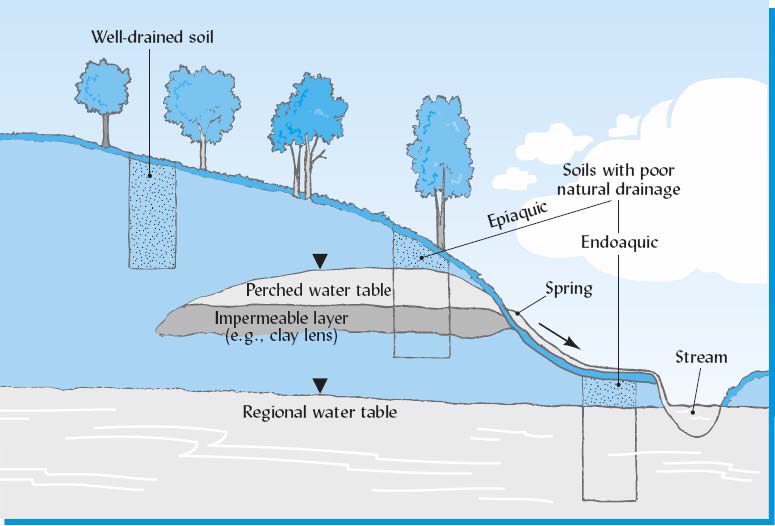 Cross section of a landscape showing the regional and perched water tables in relation to three soils, one well- drained and two with poor internal drainage. By convention, an inverted triangle identifies the level of the water table. The soil containing the perched water table is wet in the upper part, but unsaturated below the impermeable layer, and therefore is said to be epiaquic (Greek epi, “upper”), while the soil saturated by the regional water table is said to be endoaquic (Greek endo, “within”). Artificial drainage can help to lower both types of water tables. (Diagram courtesy of R. Weil)