4.18.2.1. RNA Enzymes - Ribozymes
- Definition: Ribozyme means ribonucleic acid enzyme. A ribozyme is an RNA molecule with a well defined tertiary structure that enables it to catalyze a chemical reaction. It may also be called an RNA enzyme or catalytic RNA. Many natural ribozymes catalyze either the hydrolysis of one of their own phosphodiester bonds (self-cleaving ribozymes), or the hydrolysis of bonds in other RNAs. Some have been found to catalyze the aminotransferase activity of the ribosome. Examples of ribozymes include the hammerhead ribozyme, the VS ribozyme and the hairpin ribozyme.
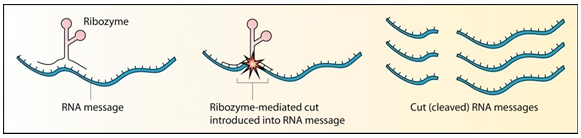
Figure 4.24: Cleavage of RNA by ribozyme
- Examples include:
- Ribosomal RNA of the large subunit of the ribosome
- Links amino acids in growing polypeptide chain
- Ribosomal proteins help orient the reaction components but are not catalytically active
- (Previously thought that ribosomal proteins carried out the reactions and that rRNA was a scaffold to held proteins in the correct position.)
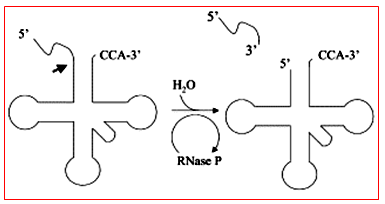
- Ribonuclease P (a less complex ribozyme)
- Processes certain transfer RNA molecules at 5’-end
- Has both RNA and protein component
- the RNA carries out the reaction
- the protein helps bind the tRNA
- RNA component works slowly on its own, especially if tRNA is plentiful.
- Self-splicing introns
- They are catalytic but only act once
- Technically they are not true enzymes
- Genuine enzymes process large numbers of other molecules as opposed to processing themselves just once
- Viroids (Infectious RNA molecules that infect plants)
- Do not encode any proteins
- RNA of some viroids carries out self-cleavage during replication
- Not true enzymes - catalytic but only act once.
- Ribosomal RNA of the large subunit of the ribosome
- Function:
- Although most ribozymes are quite rare in the cell, their roles are sometimes essential to life. For example, the functional part of the ribosome, the molecular machine that translates RNA into proteins, is fundamentally a ribozyme, composed of RNA tertiary structural motifs that are often coordinated to metal ions such as Mg2+ as cofactors.
- RNA can also act as a hereditary molecule, which encouraged Walter Gilbert to propose that in the distant past, the cell used RNA as both the genetic material and the structural and catalytic molecule, rather than dividing these functions between DNA and protein as they are today. This hypothesis became known as the "RNA world hypothesis" of the origin of life.
- If ribozymes were the first molecular machines used by early life, then today's remaining ribozymes -- such as the ribosome machinery -- could be considered living fossils of a life based primarily on nucleic acids.
- A recent test-tube study of prion folding suggests that RNA may catalyze the pathological protein conformation in the manner of a chaperone enzyme.
- Naturally occurring ribozymes include:
- Peptidyl transferase 23S rRNA
- RNase P
- Group I and Group II introns
- GIR1 branching ribozyme
- Leadzyme - Although initially created in vitro, natural examples have been found
- Hairpin ribozyme
- Hammerhead ribozyme
- HDV ribozyme
- Mammalian CPEB3 ribozyme
- VS ribozyme
- glmS ribozyme
- CoTC ribozyme
- Artificial Ribozymes
- Since the discovery of ribozymes that exist in living organisms, there has been interest in the study of new synthetic ribozymes made in the laboratory. For example, artificially-produced self-cleaving RNAs those have good enzymatic activity have been produced. Tang and Breaker isolated self-cleaving RNAs by in vitro selection of RNAs originating from random-sequence RNAs. Some of the synthetic ribozymes that were produced had novel structures, while some were similar to the naturally occurring hammerhead ribozyme.
- The techniques used to discover artificial ribozymes involve Darwinian evolution. This approach takes advantage of RNA's dual nature as both a catalyst and an informational polymer, making it easy for an investigator to produce vast populations of RNA catalysts using polymerase enzymes. The ribozymes are mutated by reverse transcribing them with reverse transcriptase into various cDNA and amplified with mutagenic PCR. The selection parameters in these experiments often differ. One approach for selecting a ligase ribozyme involves using biotin tags, which are covalently linked to the substrate. If a molecule possesses the desired ligase activity, a streptavidin matrix can be used to recover the active molecules.
- Lincoln and Joyce developed an RNA enzyme system capable of self replication in about an hour. By utilizing in vitro evolution of a candidate enzyme mixture, a pair of RNA enzymes emerged, in which each synthesizes the other from synthetic oligonucleotides, with no protein present.
- Applications of Ribozymes
- Catalytic RNAs (ribozymes) are capable of specifically cleaving RNA molecules, a property that enables them to act as potential antiviral and anti-cancer agents, as well as powerful tools for functional genomic studies.
- Recently, ribozymes have been used successfully to inhibit gene expression in a variety of biological systems in vitro and in vivo.
- Phase I clinical trials using ribozyme gene therapy to treat AIDS patients have been conducted.
- A type of synthetic ribozyme directed against HIV RNA called gene shears has been developed and has entered clinical testing for HIV infection