3.4. Hypotheses for Enzyme Catalyzed Reactions
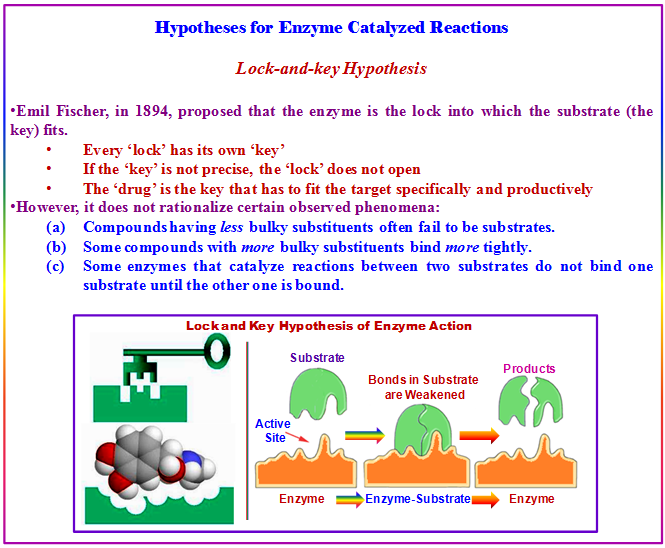
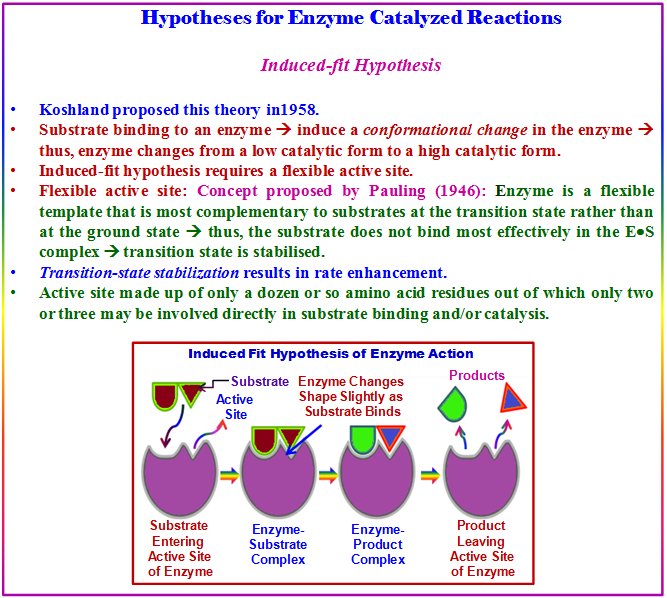
- Many different hypotheses proposed for how enzymes catalyze reactions. However, the common link of all hypotheses is- enzyme-catalyzed reaction always initiated by the formation of an enzyme-substrate (or E•S) complex in a small cavity called the active site.
3.5. Strategies of Enzyme Catalysis
- Acid-base catalysis
- A molecule other than water plays the role of a proton donor or acceptor.
- Covalent catalysis
- The active site contains a reactive group, usually a powerful nucleophile that becomes temporarily covalently modified in the course of catalysis.
- Metal ion catalysis
- Metal ions can serve as electrophilic catalyst, stabilizing negative charge on a reaction intermediate.
- Catalysis by approximation
- In reactions that include two substrates, the rate is enhanced by bringing the two substrates together in a proper orientation.
- Proximity and orientation effects
- Preferential binding (stabilization) of the transition state