
According to the condition NTU should be between 1.5 to 2. Therefore the above mean temperature value can be accepted.
TRIAL 1: To Calculate the Diameter of the Drier
Air entering the drier is 50723.27 lbs/h. But for designing purpose air is taken in excess so that the loss of heat from the drier is compensated.
Air entering the drier can be taken as ~ 51000 lb/hr.
Assume that the maximum superficial air mass velocity to be = 1000 lb/ (hr ft2)

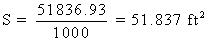
D = (4*51.837/π)0.5 = 8.07 ft = 2.46 m
Similarly length of the dryer can be calculated by using following equation
Q = Ua × S × Z × (ΔT)M
Where,
Q = Total heat, Btu/Hr
Z = Length of drier, ft
S = heat transfer area, ft2
Before that we need to calculate the overall heat transfer coefficient from:
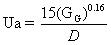
GG = Maximum superficial air mass velocity, lb/ft2 Hr
Ua = Overall heat transfer coefficient (volumetric), Btu/Hr ft3 ° F
D = Diameter of the drier in ft.

∴ Length of the drier

Z/D ratio check:
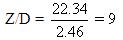
Which checks the condition that the Z/D ratio is between 3- 10. Therefore the above diameter and length can be accepted.