Example 2.2: ( Process design )
A rotary drier using counter current flow is to be used to dry 25000 lb/hr of wet solid (PTA) containing 5 weight percent water to a water content of 0.10 weight per cent. The wet solid enters at 30°C (86°F). Ambient air at 30°C (86°F) will be heated to 156°C (313°F). Specific heat of solid is 0.2871. Estimate the length and diameter of the drier.
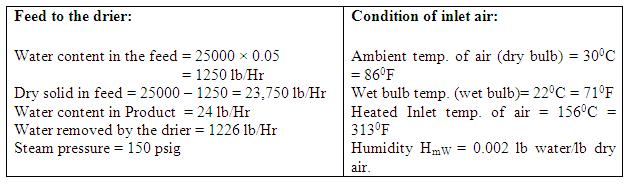

HmG Humidity of air at temperature TG° F
HmW Humidity of air at temperature TW ° F
TG Temperature of inlet air °F; TW Wet bulb temperature ° F
M Molecular weight of air; λW Latent heat of vaporization at TW ° F
hG /(mPkG ) = 0.26 for air at TW and here m = 29.
First Trail : assume wet bulb temperature is 90°C = 194°F
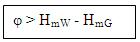
Hence at TW = 194 ° F, HmW = 0.046 ∴ HmW - HmG = 0.046- 0.002 = 0.044: λW = 547.3
φ = (0.26(313-194)/547.3) = 0.056

Second Trial : Assume a wet bulb temperature of 180 ° F
HmW = 0.065 ∴ HmW - HmG = 0.065 – 0.002 = 0.063 ; λW = 532
φ = (0.26 (313-180)/532) = 0.063
Therefore wet bulb temperature assumed is true i.e. T W = 180°F
The temperature of the outlet air should be selected on the basis of an economic balance between dryer and the fuel costs. Empirically it is found that drier operates economically when total number of transfer units (NTU) is between 1.5 to 2. (Badger and Banchero, Pg 508)
NTU = ln(TG1 - TW)/(TG2 - TW )
Take NTU = 1.5 = ln (313 -180)/( TG2 - 180) ∴ TG2 = 209°F