Drying Mechanism: The drying process can be modeled considering the outward convective flow of liquid towards the pore mouth at pellet surface where the solvent evaporation occurs. This convective flow can be described by Darcy's law and is associated with the outward flow of the precursors that is favored by a low viscosity of the solution. As the precursor concentration increases near the outer surface of the pellet due to this outward flow, an inward back diffusion of precursors, which can be modeled by Ficks law, takes place. Apart from these two flows in opposite directions, another factor that needs to be considered is the interaction between the precursor and support surface. Schematic representation of drying process during impregnation method is shown in Fig. 2.
The distribution of the precursors phase in the pellet or its segregation at the outer surface depends on the relative contribution of adsorption, convection and back-diffusion as long as the flow of solvent is high. This corresponds to constant rate period of drying.
As the solvents recedes inside the pores, evaporation occurs within the pores corresponding to the falling rate period. The drying regime is defined as slow if the constant rate period predominates and as fast if it is falling rate period controlled.
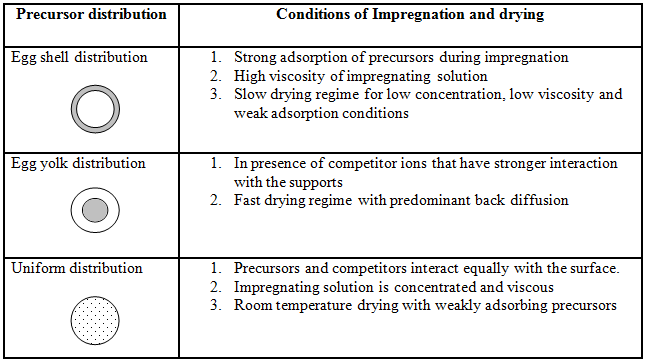
Precursor distribution : The distribution of precursors within the pores of support depends on various factors. The different conditions of impregnation and drying can result in broadly three types of precursor distribution as described in Table 1. In Egg shell type distribution the precursors are preferentially accumulated near the pore wall. This type of distribution is obtained if during impregnation precursors are strongly adsorbed on the pore wall. High viscosity of the solution also tends to result in egg shell distribution. For slow drying, egg shell distribution can result even in low viscosity and weak adsorption conditions. In egg yolk type distribution the precursors are accumulated in the interior core of the pores. Egg yolk distribution is obtained if during impregnation, the competing ions are present that have stronger interaction with the pore wall of supports. Fast drying regime with predominant back diffusion also results in egg yolk distribution. In uniform precursor distribution, precursors are uniformly distributed across the pores. If the adsorption of the solutes is weak and the time is long enough, distribution tends to be uniform. Uniform distribution also results when precursors and competitors interact equally with the surface or the impregnating solution is concentrated and viscous. Room temperature drying with weakly adsorbing precursors also tends to give uniform precursor distribution. For powders, the equilibrium is reached within few minutes. However, in case of pellets it may take up to several hours to reach a uniform distribution of the precursors.
Table 1. Distribution of precursors at different conditions of impregnation and drying.