Wet / diffusional impregnation
In this method the pore space of the support is first filled with the same solvent as used in the impregnating precursor solution. The wetted support is then treated with the impregnating precursor solution. Here the actual impregnation takes place in diffusional condition when solvent filled support is dipped in the precursor solution.
The first phase of saturation of the support by solvent involves the characteristics of the dry impregnation. But in the second phase, when solvent saturated support is added to the impregnating solution, high pressure is not developed within the pores. The precursor salt migrates progressively from the solution into the pores of the support. The driving force at all times is the concentration gradients between the bulk solution and the solution with in the pores. The impregnation time is much longer than for dry impregnation.
Wet impregnation should be avoided when the interaction between the precursors and the support is too weak to guarantee the deposition of the former.
Mechanism of impregnations: The mechanism of wet impregnation is simpler compared to dry impregnation. In wet impregnation the distribution of the solute inside the pores is assumed to be governed by two phenomena (Fig. 1):
- Diffusion of the solutes within the pores. It is described by Fick’s law
- Adsorption of the solute onto the support. This depends on the adsorption capacity of the surface and on the adsorption equilibrium constant.
The distribution of the precursors within the pellets depends on the balance between these diffusion and adsorption phenomenon.
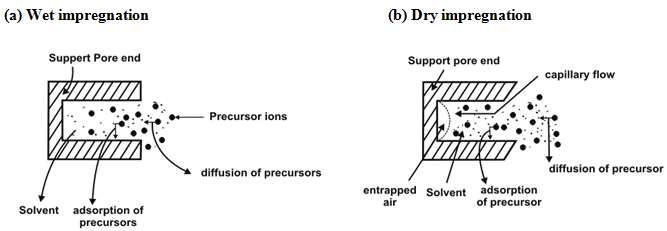
Fig. 1. Schematic representation of basic processes involved during impregnation of precursors on porous support.