Supported catalysts
Supported catalysts are prepared by deposition of the active metal on the support materials. The main purpose of using a support is to achieve an optimal dispersion of the catalytically active component and to stabilize it against sintering. But in many reactions the support is not inert and the overall process consists of two catalytic functions both for active components and support.
Supported catalysts are prepared in two main steps :
- Deposition of the precursor of the active component on the support.
- Transformation of this deposited precursors to catalytically active site.
The final active component can be in metallic state, oxide form or reduced from depending on the requirements.
There are various deposition methods. Most of these involve aqueous solutions and liquid solid interface. In some cases deposition is also done from the gas phase and involve gas- solid interface. The methods most frequently used are:
- impregnation
- ion exchange
Impregnation
Impregnation can be classified in two categories according to the volume of solution used.
Dry or incipient impregnation
In this method a previously dried support is contacted with volume of solution equal to its pore volume. The solution contains the required amount of the precursors of the active phase. As soon as the support is placed in contact with the solution, the solution is drawn into the pores by capillary suction. In case of proper wetting no excess of solution remains outside the pore space. Part of the air present in the pores is imprisoned and compressed under the effect of capillary forces. The pressure developed inside the imprisoned gas bubbles depend on the radius, r, of the curve of the liquid-gas meniscus and may reach several MPa when r<100 nm as a result of young Laplace law, 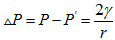 , where γ is the liquid gas interfacial tension. Considerable forces will thus be exerted on the portions of the pore walls in contact with these bubbles. The walls that are not strong enough may break down causing a degradation of the mechanical properties. Occasionally, even bursting of the catalyst grains occurs. However, the development of the high pressure is a transitory phenomenon. Under highly compressed conditions, air dissolves and progressively escapes from the solid.