Force spectroscopy: In force spectroscopic mode, the cantilever is made to approach the specimen and retracted back as discussed in previous lecture (Figure 19.5). The force between cantilever and the specimen is plotted against the cantilever deflection. The force curve thus obtained contains the information about tip-sample interaction (attraction/repulsion between tip and the specimen). Force spectroscopy also allows determination of mechanical properties such as elasticity and rigidity. Force spectroscopic curves generated from an array of points on the specimen therefore allow mapping of the mechanical properties in the specimen.
Biomolecular interaction: Biomolecular interactions can be studied by labeling the AFM probe with the ligand for the receptor biomolecule under study. The tip approaches the sample that results in the binding of ligand to the receptor. The cantilever is then retracted back; binding of the ligand to the receptors resists the retraction of the cantilever. At a critical force, however, the bonds between the ligand and the receptor are broken allowing measuring of the adhesion forces.
Protein unfolding: AFM has been used to study the mechanical unfolding of proteins. A polyprotein with terminal cysteine residues is deposited on the gold substrate; gold-sulphur bonds anchor the polyprotein molecules to the substrate . An AFM tip approaches the specimen in an attempt to adsorb a polyprotein molecule. Adsorption of the polyprotein opposes the tip retraction applying a force on the cantilever. As the cantilever is retracted further, a polyprotein molecule unfolds decreasing the force. A typical force trace showing unfolding is shown in figure 20.6.
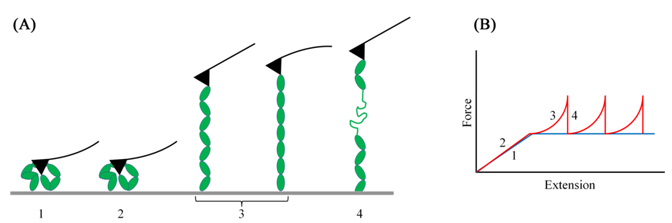
Figure 20.6 Protein unfolding scheme of a polyprotein (A), and a typical force curve (B).
Nanoindentation and mechanical manipulation: Nanoindentation is used to determine the mechanical properties of thin samples and soft materials such as biological specimens. The cantilever with a defined force is pressed against the specimen. The cantilever is not usually stiff enough to indent very hard surfaces such as metals. The softer samples, however, are indented by the tip. The indentation depth is proportional to the applied force and depends on the hardness of the specimen.
Nanofabrication: An AFM probe has been successfully utilized to oxidize the metal and semiconductor surfaces. An electric potential is applied on the tip that can oxidize the suitably prepared specimen. This holds potential for preparing microelectronic components.
Detection of defects: AFM can be used to determine the cracks and other deformations in the materials, e.g. detection of defects in the semiconductor materials and electronic chips and circuits.